Author Archives: wcw

An F for you, Bung Moktar

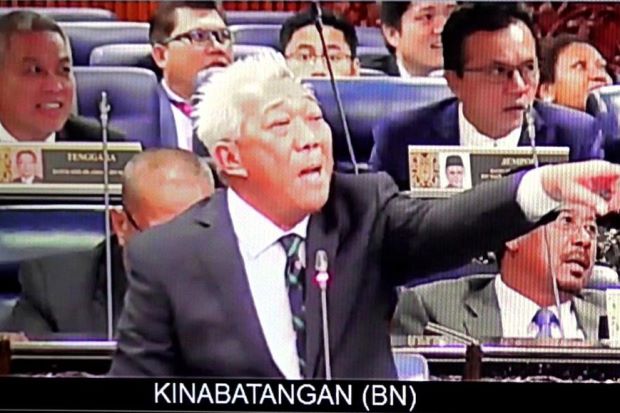
Out of order: Bung Moktar crossing the line in Parliament with an ‘F you’ retort to Mongin’s ‘casino’ jibe.

THE antics of Kinabatangan MP Datuk Seri Bung Moktar Radin at the Dewan Rakyat are familiar to most of us.

He’s a recalcitrant who thrives on earning attention from the media and Members of Parliament through his outlandish behaviour.

Members of the august House are supposed to address each other as Honourable or Yang Berhormat, being elected members, but it’ll be interesting to see how this fits the man of the hour.

After all, he is notoriously known for his crass, disparaging and insensitive remarks. They may be sticks and stones to many of us. However, last week he crossed the line when he shouted “F*** you” at a fellow MP.

He was about to question Khairy Jamaluddin (BN-Rembau) on the price of goods at the Selayang wet market when Willie Mongin (PH-Puncak Borneo) said: “Not casino, is it?”

This was in reference to widely circulated photographs of a man resembling Bung Moktar at a casino apparently in Macau.

A visibly upset Bung Moktar retorted: “What is this? You are rude. You don’t deserve to sit here. Gangster!

“You want to fight? F*** you.”

With the microphone still on, his words were clearly audible, and as expected, his expletive spread like a disease on social media.

Bung Moktar has set a new “low” for his endless string of controversial remarks in and out of Parliament.

Last year, when he debated the tudung issue, he was quoted saying: “What is the problem with wearing a tudung?

“If she is a beautiful woman, even if she wears a tudung, she would still be beautiful. If she is not pretty, even if she is naked, who would want her?”

In 2011, he said “women drivers are slow and oblivious” and in 2007, he said women “bocor setiap bulan”, referring to their menstrual cycle.

He criticised then Batu Gajah MP Fong Po Kuan in Parliament when she complained to the Speaker about the dilapidated condition of the august House’s roof which leaked every time it rained.

Mana ada bocor? Batu Gajah pun bocor tiap-tiap bulan juga.” (Where is the leak? Batu Gajah leaks every month, too).

In 2008, Bung Moktar was caught making an obscene hand gesture at some MPs during the 30-minute daily live telecast of Question Time in Parliament on RTM1, though it went unnoticed as the set cameras were off him then. He admitted to making the gesture but insisted that it was “not what it meant” and shouldn’t be construed as rude.

That year, he even insulted the disabled community by asking veteran politician (now late) Karpal Singh to stand up in a show of respect to the House, fully aware the DAP leader had been paralysed waist down following an accident.

When Germany won the World Cup in 2014, he tweeted: “WELL DONE…BRAVO…LONG LIVE HITLER”, upsetting many people.

Bung Moktar will surely continue with his ways because all he needs to do is retract his offensive remarks, apologise and move on. That’s the privilege accorded to MPs.

He’s in good company, though.

Joining him is Lipis MP Abdul Rahman Mohamad, who reportedly shouted “P****ak” in the Dewan.

In retracting the offending word, Abdul Rahman said he had wanted to “teach” DAP’s RSN Rayer (PH-Jelutong) a lesson for his slur during the previous week’s proceedings.

Rayer uttered “kepala bapak”, a phrase he also used in the Dewan Rakyat the previous week.

The DAP MP from Penang must surely be clued in to what Malaysians think of his debating skills at the Dewan Rakyat, despite being a practising lawyer.

He is in danger of edging towards a slippery slope if he continues displaying his brash manners and ignoring the voice of the people who feel he must improve on his delivery and exercise self-restraint. Theatrical responses are so passe in the New Malaysia. Keep that in your ceramah, please.

And what was Mongin thinking when posting on Twitter that he accepted Bung Moktar’s challenge to a one-on-one fight in the ring?

“Too many blunders from Kinabatangan in Parliament.

“If he insists on a fight, I accept his challenge to go one-on-one in the ring. Just let me know the time and date,” said Mongin in his entry last week.

Perhaps he was angry with Bung Moktar’s remarks: “I have seen Puncak Borneo (Mongin) having drinks with perempuan pelacur (hookers) as well.”

The truth is, Bung Moktar doesn’t even deserve a response.

Mongin can choose to sit down with whomever he wants. After all, purported tainted politicians still walk the corridors of Parliament as Yang Berhormats, passing themselves off as righteous and principled figures.

And let’s not even deliberate Pasir Salak MP Datuk Seri Tajuddin Abdul Rahman’s disgraceful tirade on race and religion, and his highly imaginative and provocative speeches on how Malaysia is in danger of being taken over by Christians.

His hate-filled speeches bordered on sedition and his remarks often targeted Teresa Kok (DAP-Seputeh):

“The only woman with a ‘Kok’ is in Seputeh.”

The nation might be crying out for a new political culture, where debates can be conducted in a more mature and civil manner.

Sadly, we haven’t seen enough of it. Instead, we are still violated by a spectacle of ill-mannered MPs unable to behave with dignity or debate intelligently (not even intellectually) and with decorum.

But MPs like Bung Moktar are doing as they please because there are no rules in Parliament which restraint lawmakers who continuously distract and disrupt proceedings, and in the process, dishonour the House.

So, if we’re asked to rate the performance of Bung Moktar and other renegade MPs, we can only give them an F for failing us miserably.
Keeping it civil

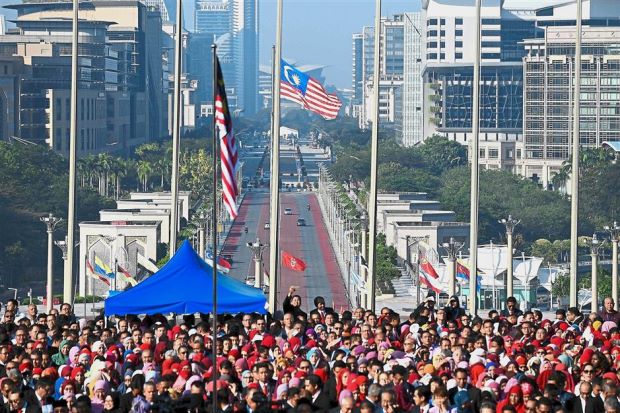
Brave new world: The civil service needs to get used to the New Malaysia approach while our ministers need to snap out of the Opposition mode and get down to work.

IT’S often said that ministers come and go, but civil servants stay forever. And the good old government machinery runs as before, a fact some of our new ministers will probably be clued into by now.

Ministers who have no experience at state government level may have pre-conceived notions of the privileges they enjoy, like unlimited authority and knowing what they decree would suffice to overrule the bureaucrats.

And that is the biggest mistake they could make as newcomers to Putrajaya, because nothing exemplifies shooting oneself in the foot more than putting down civil servants – they run the ministries, after all.

Making its rounds on the grapevine these days is how some ministers put down their secretaries-general at meetings, believing they know better, or quite possibly, that they can do a better job at improving the performance of their charges.

Some of our ministers were probably not born when British sitcom Yes, Minister (which later became Yes, Prime Minister) aired on BBC Two, and on RTM, from 1980 to 1984.

Set principally in the private office of a British Cabinet Minister in the fictional Department of Administrative Affairs in Whitehall, it follows the ministerial career of the Right Honourable Jim Hacker.

In it, he attempts, or rather, struggles to formulate and enact laws or effect departmental changes and meets with resistance from the civil service, in particularly his Permanent Secretary Sir Humphrey Appleby.

The obstructions (sabotages, some would say) were often carried out so deftly that the minister would often rarely know what hit him or possess a trail of evidence to prove insubordination.

In fact, the delays (such as total rejection of policy) were cited to impress upon the minster that the shenanigans were for the benefit of his political mileage.

But of course, the sitcom was totally fictional and in real life, not all civil servants could get away like that.

Respected banker and commentator Tan Sri Dr Munir Majid wrote that Prime Minister Tun Dr Mahathir Mohamad had put together a Cabinet with a mix of races and genders, and a range of ages, which is unprecedented in the political governance of our country. However, except for a handful of ministers, the Cabinet falls short on experience.

Dr Munir urged Pakatan ministers to get out of “Opposition mode” so they can function and deliver with all the advice and support available.

“They would need to get the government machinery – the civil service – to implement their decisions effectively.

“Here, there is another problem. The largely Malay civil service is not used to having political masters committed to a multi-racial Malaysia and a no-nonsense regime,” he wrote.

That simply means our ministers, who have been used to merely delivering fiery speeches, now need to roll up their sleeves and get down to work and show the fruits of their labour. They can only blame the ills and corruption of the previous government to an extent.

A few ministers, and even the Attorney-General Tommy Thomas, must now grapple with all the documents being in Bahasa Malaysia, unlike in the private sector where the medium of communication is English.

Their staff would most likely be entirely Malay, except for their aides, who are political appointees. Directives would be issued in an entirely different way, obviously reflected by the work culture and style of communication.

That is just how the civil service works, so, they simply need get used to it. Of course, stories of all this being a culture shock for some have surfaced recently.

Dr Munir reminded that “there is still some way to go to arrive at a New Malaysia in terms of multi-racialism. After two generations of ‘Malay First’ and subsequently ‘Malay and Muslim First’ political ethic, there is a mountain to climb to make it New Malaysia.”

The reality is that about 75% of the Malay electorate in GE14 voted for Umno or PAS, in comparison to 95% of the Chinese voters who voted for Pakatan Harapan (an increase from the 85% who supported the now-defunct Pakatan Rakyat coalition in 2013). About 70% – 75% of Indians voted for PH, the figures show.

It has been reported that only 25% – 30% of Malays voted for PH, according to figures from Merdeka Centre. Apparently, 35% – 40% of Malays voted for Barisan Nasional while 30% – 33% supported PAS.

The findings displayed that although a higher percentage of Malays voted for Pakatan Harapan in Johor and in west coast states such as Melaka and Negri Sembilan, the coalition’s overall Malay support was diminished by its weak performance in Kelantan and Terengganu.

It’s no secret that as the new government reaches its 100-day mark, some ministers are still struggling to assemble their offices.

It’s just as well that some have yet to meet the press or make statements, because they are still learning to juggle the workload as others continue their scramble to find the ideal personnel.

The job has been so overwhelming that they have been unable to meet their key officers to solidify plans and directions.

With no appointments in sight, some staff are wondering if they are being snubbed, or simply that the ministers are too busy with other engagements. It doesn’t help that they don’t even reply messages.

But the civil service needs to accept that this is New Malaysia. There is no turning back. The culture of openness, accountability, engagement and success must take centre stage, with any form of prejudice left by the wayside.

The strategy of using race and religion to stir emotions seems hollow now.

Millions of ringgit were stolen from the people by those in power, and as the facts have revealed, they weren’t Chinese, Indians or Christians, contrary to what these politicians still want the Malays to believe.

And certainly, the civil servants who sniffed out the moral decay under their very noses knew exactly what was happening.

Clean, trustworthy and competent ministers, and a loyal, non-corrupt and efficient civil service will make Malaysia great.

After all, as the saying goes, it doesn’t matter what colour the cat is, as long it catches the mice.

In this context, what’s important is surely them being good Malaysians.

Ministry feeling the squeeze

Heavy responsiblity: Dr Maszlee is fast realising that heading the Education Ministry is not only a mammoth task but also one that is often embroiled in political drama.

IT must now have dawned on Education Minister Dr Maszlee Malik that he sits in a hot seat. A role as university lecturer is a different ball game altogether from heading an entire ministry.

Previously, there was the Higher Education Ministry, which oversaw the higher institutions of learning, and the Education Ministry, tasked with looking after schools. Now, everything is housed under a single ministry.

It is a mammoth task, no doubt, and certainly one not helped by knowing how the ministry is often embroiled in political drama.

Decisions by the minister directly impact millions of Malaysians, particularly teachers, parents and students.

Almost every Education Minister in the past has attempted to leave a mark, or tried to make a difference, but they have all only disappointed us.

Whether they are changes to the syllabus, textbooks, school terms or even names of subjects, we’ve run into the handiwork of these politicians more times than we’d like to remember.

Although each of them made cosmetic changes, none of them, unfortunately, affected a profound difference in their duty – improving the standard of our education system in schools and universities.

The strings of distinctions, which our students brandish from public examinations, fall short because of the glaring difference in standards. Realistically speaking, an “A” in Malaysia could well just be a “D” in some examination papers overseas.

The grading system in science subjects, for example, has long been a bone of contention, and no one really seems to know how it works.

And regardless of where our students may be studying, at national, Chinese or Tamil schools, their proficiency in English has continued to deteriorate. As if to throw a spanner in the works, it’s not just the students who are weak – the ones teaching them English aren’t very good either.

None of these teachers and students can be blamed though because they are victims of the education system which taught them. Unfortunately, most of us are now paying the price through our communication, written or verbal.

Dr Maszlee has found himself having to clarify and even backtrack on previous decisions recently, too. Last week, after being criticised, he had to change his stand and promised financial aid to Chinese independent high schools (SPMC) under the federal development budget.

Earlier, he said SPMC couldn’t receive allocations to pay teachers’ salaries since they’re not government schools.

“Operation allocation covers the government’s internal expenses. Most of the allocations are for civil servants and teachers’ emolument.

“As SPMC is not a public school or under the ministry’s purview, and its teachers are not civil servants, the ministry cannot use operation allocation for SPMC, private religious schools and other private education agencies.”

In his written reply to Ayer Hitam MP Datuk Seri Dr Wee Ka Siong, Dr Maszlee said independent schools wouldn’t be funded since they don’t come under the purview of the education system.

The Unified Examination Certificate (UEC) issue has also continued to dog Dr Maszlee, with lingering doubts over his stand.

He had reportedly said that recognising the UEC may undermine the status of the national language and national unity, adding that PAS and Umno Youth had also echoed similar sentiments.

The Simpang Renggam MP also previously said that a “holistic approach” towards any decision to recognise the UEC is needed to ensure both the national language and national unity weren’t threatened, adding he wanted to avoid unnecessary U-turns on the issue.

And after being struck by a barrage of criticisms, he made a political statement saying the only one in conflict is Barisan Nasional, with MCA deputy president Wee and the party standing on one square and (Umno Youth chief) Datuk Asyraf Wajdi Dusuki standing on another.

More controversy was to follow. First, he announced the Government’s firm implementation of the black shoe standard for all students from next year. But after taking on the brickbats head on, he agreed to a year’s grace period to enforce the switch of white shoes to black pairs.

His announcement to raise funds for our financially-strapped universities by selling number plates to the alumnus also raised a ruckus, even if his intentions were noble.

So, the 43-year-old minister’s faux pas have given the impression that he isn’t in tune with the job or the stakeholders.

He shouldn’t be too quick to make inconsequential changes while still learning the ropes.

Unfortunately for him, his ministry is one huge minefield, where one slip of the tongue could blow up in his face. And in a political environment where Malaysians have become more demanding, he would have to live with constant scrutiny and judgement.

The Johorian has been pummelled on social media, taking blows no less from pro-Pakatan Harapan bloggers. This won’t do his credibility, and consequently, confidence, one bit of good.

Dr Maszlee is surely feeling the weight of the world on his shoulders now. So, he needs plenty of support and help. However, he must realise that the honeymoon period of 100 days is fast drawing to a close. The media is already saying that he is difficult to reach, and this incommunicado business even includes his senior aides.

This surely can’t be the best way to go about things, can it?

Baby love no more

IT’S enough to make anyone’s stomach churn how a 41-year-old man could take an 11-year-old child as his wife, and later proudly confess that he had wanted to marry her since she was seven.

Worse still, it’s frightening and sickening that he had the audacity to concede his wish to marry her showed it wasn’t an act of lust. His latest revelation is more revolting than the earlier news of his marriage to the underage girl in Thailand.

BH Online quoted the man from Gua Musang, Kelantan, as saying that they would have already moved in together if he only married her to satisfy himself. Instead, he has opted to wait five years for her to turn 16.

The rubber tapper and religious teacher said he was unsure what drove him to marry the girl, but claims it wasn’t spurred by desire.

“I knew Ayu since she was little because we were neighbours, and I taught her Al-Quran lessons. It was then I told myself that one day, I will take this girl as my wife, and I did so four years later,” he reportedly said.

Incredibly, he expects Malaysians to believe him when his own family members – including his first two wives – found his decision to marry a minor appalling and decided to spill the beans on him.

There is no other way – we must end child marriages. There is simply no justification for such paedophilic acts. What’s worse is, religion is being used to legitimise it.

Innocent teenage crushes are common, which is part of the growing-up process, but when it involves a married man who has two wives with an 11-year-old child, that’s an alarming story.

Shockingly, the religious authorities have their hands tied and can do little beyond imposing a fine on the man for an administrative bungle.

On July 10, the Gua Musang syariah court let him walk off with a mere RM1,800 penalty for marrying a minor without prior consent from the court and for engaging in polygamy without permission from his spouse. His marriage to the child bride in Narathiwat, Thailand, took place on June 18.

Despite national condemnation, the man has refused to give in to public pressure to annul the marriage.

His children are also stuck with the reality that they now have an 11-year-old stepmother. One can only imagine the trauma they have to endure.

His children are said to be between five and 18 years old, one of whom is even friends with the girl.

It doesn’t make sense either that Deputy Prime Minister Datuk Seri Dr Wan Azizah Wan Ismail declared it “was not wise to prejudge the issue before all the evidence is brought together and the investigation is complete.

“The actions we take in dealing with this alleged incident of child marriage must be based on evidence. We will issue a statement on this matter only after the investigation is complete,” she reportedly said.

The man has already admitted he has been in love with the minor since she was seven. Now he has officially married the girl in Thailand. So, it is no longer an “alleged case”.

But since religious issues could come into play, things could get complicated for what would otherwise be a straightforward matter. It’s not the 1MDB case, after all.

In Malaysia, the furore gets incredibly loud when deliberating the subject of homosexuality. And in more extreme instances, some of the ill-educated aren’t even tolerant of liberals.

Yet, they seem to be disturbingly silent when it comes to child marriages. If it had involved their own children, though, they would have screamed bloody murder.

Child marriages are a gross violation of human rights as they deny girls the right to health, education and a life free from violence and exploitation, which is clearly enshrined in the Universal Declaration of Human Rights, Convention on the Rights of the Child (CRC), Convention on the Elimination of All Forms of Discrimination Against Women (CEDAW), and other international and regional human rights institutions.

In 2016, the then Women, Family and Community Development Minister Datuk Seri Rohani Abdul Karim told Batu Kawan MP Kasthuri Patto in a written reply that the number of applications for Muslim child marriages between 2005 and 2015 was 10,240. The figure for the approved applications was not provided.

The annual average of applications for Muslim child marriages recorded by the Department of Syariah Judiciary Malaysia between 2005 and 2010 is 849, while the annual average for 2011 to 2015 is 1,029, Rohani said.

Non-Muslim child marriages recorded by the National Registration Department between 2011 and September 2015 stood at 2,104 with girls aged between 16 and 18, Rohani said. Most of these teenage girls (68%, or 1,424) were married off to men aged 21 and above, while the rest (32% or 680) found themselves tying the knot with those closer to their ages of 18 to 21.

The Syariah Lawyers Association explained that “under the Syariah law, only (a) person who has attained puberty can get married. The age of puberty may differ from one person to another, though, so proof is required in any application for underage marriages.

“Of course, there are other factors that need to be considered by the court before allowing or rejecting the application,” he said, adding that requests for Muslim underage marriages are not automatically approved, needing evidence to show merit first.

Its deputy president Moeis Basri said on Malay Mail Online that Syariah courts were bound by Syariah laws, whether they are codified or otherwise. In practice, he said this means that Syariah judges will exercise their wide discretionary powers to consider all relevant factors before approving underaged marriages.

This includes examining physical signs to see if the girl has begun menstruating, and the level of maturity in both the child bride and groom-to-be.

In response to the incident, which has earned nationwide ire, the campaign #pelajarbukanpengantin (#schoolnotspouse) to end child marriages – which involves a group of non-governmental organisations and individuals – has kicked off.

Deputy Women, Family and Community Development Minister Hannah Yeoh, Permatang Pauh MP Nurul Izzah Anwar and Klang MP Charles Santiago are among many who have pledged their support.

In his Facebook post earlier this week, Santiago said: “It’s about time that we have open discussions on the issue of child marriage for it deprives a child of her rights and robs her off a childhood as well, not to mention the physical, sexual and emotional trauma.”

In our heart of hearts, most of us can tell right from wrong. We may not wish to speak explicitly about such matters, especially if it involves religion, but surely, we all wish to do the right thing.

We simply can’t endorse these kinds of despicable marriages, whatever the reasons may be.

Storm brewing in a teacup

Not an easy feat: GE14 saw a change of Government but it will take time to change people’s mindsets, cultures and deep-rooted prejudices.

CALL me naive if you want, but will we ever get past our obsession with race, religion, gender, marital status and sexual orientation?

And for some strange reason, we are prepared to “overlook”, even become apologists, for corruption and child marriages.

Some of us have the most absurd defence for corruption, even if it’s of global magnitude. As for paedophilia, we condone and accept it as the way for child marriages.

But when it involves race, religion and gender, we choose to look the other way, even when the rights of the minority are trampled on.

Most of us are too meek to defend them because we fear the backlash for daring to stand up and speak for them.

In the age of social media, the incessant attacks are far worse, naturally. So, don’t count on too many people to have your back. They may have appeared fearless, or outspoken on other issues, but if their hide is on the line, it becomes a very different story.

As much as we would like to think a new political culture has unravelled in the post-general election euphoria, along with the birth of what we believe to be a New Malaysia, the sobering truth is, we may be in for some disappointment, set against a rising tide of expectations.

Lawyer Syahredzan Johan hit the nail on the head, saying Malaysians voted to change the party in charge of the Government. But that didn’t change mindsets, cultures or deep-rooted prejudices.

“This is the reality that we must operate in. It’s easier to change the Government than to change people,” he tweeted last week.

The reality is, Malaysia is becoming an increasingly religious and conservative country, and as the results of the general election become clearer, Pakatan Harapan lawmakers must now be intimately aware that only 30% of Malays voted for them. But 95% of Chinese and between 60-70% of Indians chose Pakatan.

To be fair, though, Malay loyalty was divided between the Umno-led Barisan Nasional, PAS and Pakatan, according to the Merdeka Centre estimates.

Analysts and politicians believe the three-way split has big implications for Malaysia in the coming years, since there will be a tug of war for Malay support between the political factions.

Some 35-40% of Malays voted Barisan, 30-33% supported PAS, and 25-30% picked Pakatan, according to Merdeka.

Amid Barisan’s failure, don’t forget that PAS emerged strongly in GE14 as it swept to victory in Terengganu, tightened its grip on Kelantan, and encroached into Barisan’s “fixed deposits” on Felda turf.

In fact, the party won enough seats in Kedah (15 against Barisan’s three and Pakatan Harapan’s 18) and Perak (three seats against Barisan’s 27 and Pakatan’s 29) to be formidable.

Progressive urbanites won’t be tickled by these stats as it means Pakatan isn’t likely to force the issue, simply because there is political value to voters who still cling on to racial and religious prejudices.

So, many of us will have to live with Indian rabble rouser Dr Zakir Naik remaining in Malaysia. There’s no way the Prime Minister hasn’t seen that video that’s furiously making its rounds, in which the preacher uses Islam to justify to a member of the audience why she shouldn’t vote for Tun Dr Mahathir Mohamad.

And should we hold our breath expectantly to witness the shuttering of the Department of Islamic Development Malaysia (Jakim) or the Biro Tatanegara (National Civics Bureau)?

PAS information chief Nasrudin Hassan now claims that the appointments of senior judge Richard Malanjum as chief justice, as well as Liew Vui Keong as de facto law minister and Tommy Thomas as attorney-general by the Pakatan government, have sparked restlessness among Muslims.

Umno supreme council member Datuk Lokman Noor Adam, meanwhile, has threatened to stage a protest against “an alleged attempt by DAP to make Christianity the official religion in Malaysia”, by marching to Parliament.

As outrageous and pathetic as it may sound, we still hear such noises. So, presumably they have an audience, or so they believe.

So, it wasn’t surprising when activist Numan Afifi Saadan recently announced that he had no choice but to step down as Youth and Sports Minister Syed Saddiq Abdul Rahman’s interim press officer following backlash over his LGBT rights activism.

Numan reportedly said the backlash and threats from the “opposition propagandists” had made it impossible for him to exercise his duties.

“Therefore, I have decided not to work with the Ministry in any official capacity,” he said, adding that he will be handing over his responsibilities to a new press secretary to be appointed soon.

Numan then clarified that he was never officially appointed by the Youth and Sports Ministry, despite his name appearing on its official website.

His name had reportedly been listed on the ministry’s website as “special officer”, but was subsequently removed.

No one was prepared to defend him. Not even Syed Saddiq, who beyond thanking him and saying the former will always be his “bro”, did little else.

Klang MP Charles Santiago was the only lawmaker who dared speak up about something he felt was wrong, pointing out that “gay rights are human rights, too”.

Before Numan’s resignation, Santiago pledged solidarity with Numan but was swiftly criticised for supporting the LGBT community.

Hats off to Santiago because he stood up for what he believed in, and despite the condemnation, remained resolute with his stand.

There are enough news reports of our transgender community being bullied, either by mobs or religious authorities. Tragically, they have continued to face such tyranny, as if they have no rights and dignity as human beings.

It’s easy to pretend that they don’t exist. Of course, if you are a family member of a powerful political family, or belong to a party in power, you are supposed to be treated accordingly. However, if you are not politically linked, then you need to call that blonde lawyer Siti Kasim.

Disappointingly, the presence of Sabah Chief Minister Datuk Seri Mohd Shafie Apdal at a thanksgiving event of his Parti Warisan Sabah colleague last weekend became a religious issue, too.

So, in Malaysia, we fuss about our countryman’s race, religion, gender and even the colour of the person’s hair, or their tattoos, when we should be more concerned about the person’s ability, skill, competence and integrity.

Hasn’t Malaysia been ripped off of billions of ringgit by those who thundered about race and religion from the rostrums?

It’s only at the death bed at the hospital – when we request the best doctors and nurses – that race, religion, gender and other preferences are no longer controversial. That’s when hypocrisy ends.