Author Archives: wcw

Food for thought

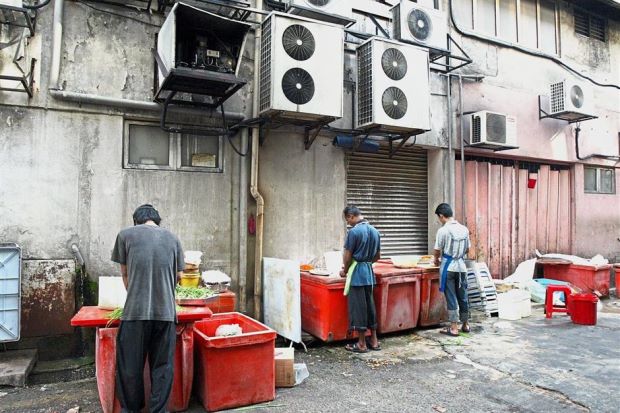
Total disgrace: Many restaurants extend their food preparation and washing up areas to the rear of their premises which is unhygienic and unlawful. The workers washing their food trays in a pothole filled with putrid, gutter-infused rain water last week must be one of the worst cases of hygiene-flouting in recent memory.

MALAYSIANS know how to enjoy their food but, but the trouble is, we never really pay attention to hygiene standards at eateries.

Many of us are guilty of being extremely tolerant, so long as we like the food served, even if it’s the product of a dirty restaurant.

We turn a blind eye on how the food is prepared – we don’t mind the filthy greasy floor or that we sit next to the drain, or even near the toilet. And let’s not even get started on the conditions of the restrooms in some of these coffee shops.

Of course, it’s a wonder how health officers and council staff continue to allow such premises to operate.

Is this down to the lack of manpower, inspectors incompetent at their jobs, or (as we often conclude), corrupt officers at work? Or is the classic bureaucratic excuse at play: no official complaints were filed?

The video clip of workers washing food trays in a pothole filled with putrid, gutter-infused rain water last week, must be one of the worst cases of hygiene-flouting in recent memory.

It’s a total disgrace for Raj’s Banana Leaf restaurant chain to blame this outrageous oversight of basic hygiene laws on their workers, supposedly new, and presumably foreign.

The Star Metro has long been highlighting the problems of cockroaches, rats and filth, which have continuously infiltrated food outlets in the city, despite Kuala Lumpur City Hall (DBKL) shutting down such places to ensure cleanliness is adhered to.

DBKL Health and Environment Department director Dr Hayati Abdullah was quoted saying that there is little the local authority can do to stubborn operators who don’t fear facing the axe.

Since throwing the book at them involves a lengthy process, she has urged consumers not to patronise dirty outlets, which hopefully puts a dent in their business.

These eateries know that they would only be shuttered for a finite period, and paying fines is nothing more than a slap on the wrist for these errant restaurant owners.

Perhaps it’s time that DBKL puts up a micro site where it lists down the names of restaurants that have been booked and suspended. A wall of shame of sorts should impact these stubborn owners to shuffle their feet and do what’s right.

If DBKL can’t do it, it will only be a matter of time before netizens become vigilantes and hang these dirty eateries out to dry themselves.

Dr Hayati also echoed those sentiments, saying that the “majority of people continue to eat at unlicensed and dirty eateries.”

She revealed that their inspectors conduct daily checks, with major inspections done once a week.

DBKL aspired to introduce longer punishment periods, but with businesses served with notices refusing to shut up shop, enforcement remains an uphill climb.

“We have limited resources and cannot keep tabs on every restaurant every day. We have a schedule to follow,” she explained, highlighting the plight.

Restaurants found with pests and bad food handling methods, she said, would be forced to cease operations until they meet the required standards, while those with minor offences, like dirty floors, would be compounded.

Dr Hayati said all actions were in accordance with the 1979 Food Handling By-law, 1985 Food Establishment By-law, and the Food Act 1983.

However, the problem isn’t merely confined to the capital, but spread throughout Malaysia. Anyone who has travelled to Britain, Japan, Australia or Hong Kong, can vouch for the high standards of hygiene restaurant owners there maintain because of strict laws and requirements imposed to retain their licenses.

It isn’t just about kitchens and eating areas, but toilets, too. It’s safe to say that nearly all coffee shops don’t come with toilet rolls in their washrooms. And I always wonder what tourists think when we brag about Malaysia being a food paradise.

And at many roadside stalls, toilet rolls are serviceable substitutes for good ol’ serviettes, where customers are expected to wipe their hands and cutlery with them. Obviously, these stall owners can’t distinguish between the use of both disposable towels, or worse, don’t see the importance in their differing applications.

Our back lanes are also poorly maintained. Try walking along them around SS2 in Petaling Jaya, especially the commercial areas where many restaurants do brisk business. They are gross, and one wonders whether these alleyways are cleaned at all.

Many of these restaurants, unfortunately, extend their food preparation areas to the rear of their premises, which is, of course, unlawful.

My senses were violated recently when I saw a famous roasted duck stall in Damansara Uptown placing its ducks to be dried along the back lane. And we all know many chicken rice stall owners are guilty of such practices.

And as certain as the sunrise, two weeks from now, this issue of dirty eateries will be consigned to the back lanes of our memories, too, unfortunately.

It will be business as usual for the stake holders as the good times roll once more. The question is, why do we allow these eateries to continue operating like this?

It must now be made mandatory for all restaurants to place a conspicuous sign for customers to glean details to file complaints via their mobile phones – along with a picture or video – through the appropriate channels. The time to act is now.

Pretty hate machine

Controversial: The BTN has been accused of promoting racism, bigotry, disunity and intolerance in the name of instilling patriotism through its activities, like this in the National Transformation Training Programme.

IF there’s one government agency which needs a complete overhaul by the new federal government, it must be the notorious National Civics Bureau, better known to Malaysians as Biro Tatanegara.

Over RM1.1bil of taxpayers’ money has been outrageously spent to promote racism, bigotry, disunity and intolerance in the name of instilling patriotism.

The BTN was set up in the 1970s as a Youth Research Unit under the Youth Ministry. But by the 1980s, the obscure agency had evolved into the BTN we know, and placed under the Prime Minister’s office.

Its objective is to nurture the spirit of patriotism among Malaysians, and train them into future leaders who are “well-rounded intellectually, emotionally and spiritually” to support national development efforts.

This monstrous machine was wellfed, not just during the Najib administration, but during the reign of the Mahathir administration as well. And certainly, Datuk Seri Anwar Ibrahim, too, used it as a political tool.

But that’s in the past. Malaysia has rebirthed. And as the perfect paradox, only Tun Dr Mahathir Mohamad, as the new prime minister, can set things right again.

Anwar would surely support any move to review, if not, bury the BTN, because he ended up the bogeyman in its lectures in later years while he was in the political wilderness.

The BTN has been fraught by controversy for over three decades, with allegations of racism and political propaganda mainstays.

It is inconceivable that good taxpayers’ resources are poured into such an organisation, which many participants have said, blatantly drums up race and hate politics.

BTN’s brickbats come from either side of the political divide, yet the uproar seems to have fallen on deaf ears, presumably shackled by the lack of political will, or worse, tacit political support from the top.

In 1999, PKR leader Nik Nazmi Nik Ahmad claimed that the BTN camp he attended was “racial and political in nature,” with trainers impressing on attendees that Malays required affirmative action. It even criticised PAS as “deviationist.”

Another party leader, Amirudin Shari, said “participants are indoctrinated with propaganda about ketuanan Melayu” or Malay dominance.

Another alumnus alleged she was told “the Malays were the most supreme race in the world, we were God’s chosen few, that the others were insignificant. We were warned about certain elements in our society and abroad, determined to undermine Malay excellence.”

In 2009, then minister in the Prime Minister’s Department Datuk Seri Nazri Aziz ticked off BTN, squashing excuses raised in a Parliament debate that allegations of racist teachings might have come from mere “minor slip-ups” by BTN lecturers.

“Don’t think that people outside do not know about the syllabus based on patriotism for Malays. They know what the syllabus is all about, so who are we to say that it did not happen? You want to lie? You make people laugh.

“I mean, there are people who attended the courses who came out very angry. There were many instances of the use of words like Ketuanan Melayu. It is ridiculous. Do they want to say that Malaysia belongs only to the Malays and the government is only a Malay government? Should only the Malays be given the spirit of patriotism? Other races are not patriotic about their country?”

As Dr Mahathir settles in and combs through the list of government agencies, this is surely one Malaysians would want scrutinised as part of the process of trimming the fat.

In a piece in Malaysiakini, the writer aptly said, “the BTN is an anathema to the need to nurture critical and creative thinking among Malaysians.”

While it began as a youth research unit in 1974, under the Youth Ministry, it was reinvented as the BTN in the PM’s Department under Dr Mahathir.

BTN was run by many supporters of Anwar, himself a regular speaker at these courses, though he would come to regret the things he said then.

It has turned into an ethnic hate machine, as one writer put it, and has metamorphosed into an out of control monster.

Surely, Dr Mahathir wouldn’t have imagined what it has become. Even if he allowed it to evolve into a political tool to indoctrinate civil servants and scholarship holders, especially Malays, it is time for him to sort this out.

BTN may have been set up with the noble intention of “nurturing the spirit of patriotism and commitment to excellence among Malaysians, and train leaders and future leaders to support the nation’s development efforts”.

But that’s not what has happened. It has, instead, from all accounts, attempted to instil hate and prejudice among Malaysians, aspiring to produce leaders and future leaders with a jaundiced view.

Malaysians would remember that in September 2010, BTN deputy director Hamim Husin was reported for referring to the Chinese as “si mata sepet” (the slit-eyed) and Indians as “si botol” (the drinkers) during a Puteri Umno closed-door function.

Despite the outcry and media revelations, BTN was allowed to continue as it is, and with huge allocations streamed into these indoctrination camps.

According to Lim Kit Siang, the budgets for BTN multiplied tenfold in the 1990s (RM200mil) compared to the 1980s (RM20mil), and continued to increase. It more than doubled to over RM550mil in the first decade of the 21st century. From 2010 to 2015, the allocation for BTN totalled some RM365mil.

Now that the DAP is part of the government, it should be able to push for the right course of action, given its consistently strong stand against the organisation.

This is the most opportune time to can BTN. Malaysians believe the new federal government won’t be angling to allocate more funds to keep this monster alive.

Man in the mirror

A new government, a new political culture, and for Malaysians, a much more modest working practice by our national leaders – these are among the things that need to take shape.

However, no one expects our ministers to travel economy class, take selfies as branding exercises during their first days in office, like most do, and then sidle into business class when public scrutiny has worn off.

There isn’t anything wrong or extravagant with travelling business class, especially for long-haul flights. It’s ridiculous to begrudge them for travelling in comfort.

Surely, we expect our leaders to have sufficient rest, coupled with some privacy when they travel, so they can focus on their work when they arrive at their destinations, especially for international engagements.

But we must impress upon our newly-minted leaders to put a stop to the malaise of moving around in an entourage.

Ministers shouldn’t expect to have a battalion of ministry officials, party leaders, supporters and hangers-on awaiting them at airport arrival halls. This is nothing more than a display of self-importance and entitlement.

It’s also time our long-suffering diplomats in foreign missions are freed from the drudgery of playing tourist guides and chauffeurs to our Malaysian big shots and their wives.

It makes no sense for them to be waking up in the early hours and heading to Heathrow to wait for ministers to arrive. Pay for your own transport if you are not on official duties, please.

We must surely have better ways to while our time away than register our presence with these Yang Berhormat Mentri. Yet, this has frequently happened in the past.

Most of us know the humble ones, such as Datuk Seri Mustapha Mohamed and Datuk Seri Idris Jusoh. Mustapha is known for his simple, frugal and austere ways. He takes the ERL from KL Sentral to KLIA alone without fuss, and also patiently awaits his turn, like every ordinary Malaysian, at clinics or hospitals, without expecting preferential treatment.

When he makes his weekly visits to his constituency in Jeli, Kelantan, he cycles to the mosque near his home, an abode as average as those of other villagers. And when Mustapha visits Kota Baru, he stays at a modest hotel.

The other exemplary statesman is late Kelantan Mentri Besar Datuk Seri Nik Aziz Nik Mat, who lived in a simple wooden house with the family, minus the trappings of power preferred by some politicians.

In London, it isn’t out of the ordinary to see the Prime Minister or Cabinet ministers taking the Tube. It’s also well known how former London Mayor Boris Johnson would hop on his bicycle to events without fanfare and often arriving unannounced.

Of course, the cool weather helps, but the point is, they have no airs and don’t expect to be driven with outrider escort.

Privileges like these were only accorded to the Prime Minister and his deputy here, but of late, even high-ranking officials were enjoying these services of prestige.

It’s not like we expect them to lead spartan lifestyles, like that of Gandhi’s, but the days of wasted resources and extravagance should come to an end.

I have even seen deputy ministers and their aides boarding a plane before everyone else, on a routine 45-minute Firefly flight from Penang to Subang.

The aircraft doesn’t even come kitted with business class, and these VIPS have booked the best seats anyway, yet, there is a jostle for first dibs. These leaders seem oblivious to their disrespectful attitude, which isn’t lost on other passengers who find such cushy service in poor taste.

Malaysians hope the new government will summon a new political culture where informality can be the hallmark of our elected representatives to endear themselves to the people.

Can we also make our events attended by VVIPs short and simple? Do we really need to splurge on performances, which seem to be standard practice now?

And is the organiser responsible for providing a room for idle chatter, to enable the VVIP to then make a grand entrance into the hall?

Google reveals a holding room to be a space located in a licensed facility for the storage or holding of human bodies, prior to being disposed.

Well, that’s one interesting meaning, surely. Another definition is that it is a place for candidates sitting for an examination to wait in before the test begins.

For hospitals, the holding room is where final preparations are made before a patient is wheeled into the operating theatre. Here is where he gets to meet the surgeon, the anaesthetist and other members of the surgical team.

In Malaysia, however, the holding room is where the VIP – who is the guest of honour for an event – spends barely 20 minutes before revealing himself in grand style.

As I wrote in a piece before, the holding room, naturally, must be paid by the organisers despite it being under-utilised. There have also been instances when the VIP had no need for the holding room because he was late, or simply had no inclination for such formalities. The time has come for Malaysian politicians to encourage organisers of such events to dispense with this profligate practice.

I’ve had the opportunity to see first hand how British Prime Minister David Cameron dismissed with such protocol by walking straight into the hall and making his presence unceremonious.

A couple of years back, I attended the launch of a sales gallery for a housing project in a suburb in Sydney. The Malaysian developer and his staff eagerly awaited the mayor’s arrival in an official car, but instead, he surprised everyone by walking to the event.

In Singapore, Cabinet ministers are not judged by the column inches they hog in the media, but by their performance. Their informal style, rid of the obligatory entourage, is common knowledge.

Let’s do away with protocol and focus more on the work at hand and the people’s needs. It’s time to end these “syok sendiri” (self -indulgence) routines. By and large, Malaysians are tired of the protocol for politicians.

Placing such elitist barriers doesn’t help them one bit because it gives the impression that they are special and must be treated so. The rakyat loathe this, and more so when these politicians constantly declare themselves the people’s representatives.

Ultimately, our politicians must decide if they wish to serve the rakyat or have the rakyat serve them.

It may be a Malaysian quirk to display hospitality and appreciation by presenting a gift or memento – as we call them here – at such events. But the fate of these items alternates between ending up collecting dust and being disposed of.

There is a dire need to relinquish other over-blown and over-hyped protocols, and instead, choose a way of attendance with greater humility.

And can we get straight to the point when speeches are made, without having to address every honorific such as Tan Sri, Puan Sri, Datuk Seri, Datin Seri, Datuk and Datin, and instead, settle on the ordinary mortals?

These time-consuming salutations, which are seemingly feudalistic of the speaker for having to address every important person present, need to be canned.

Naturally, overnight changes aren’t expected, despite growing anticipation and expectation. The new government will require a grace period to settle in, and certainly, the new ministers will need room to manoeuvre into their new posts.

They should expect to become government leaders and speak accordingly, and not as the opposition’s voice. Criticism is par for the course in this career choice, so preparation is key for them, especially where press freedom is touted, yet flouted. But everyone deserves a fair chance.

The Barisan leaders will also need time to adjust to their role as opposition figures. It is a position they surely don’t fancy, but they will need to hone their combative skills for future challenges.

A new Malaysia is dawning, and along with it needs to exist a change in the way we do things. Let’s keep the good and discard the bad. No doubt it’s a daunting task, but let’s at least try.

The beginning of a new chapter

Shock win: Pakatan Harapan defied the odds to win the 14th general election and now is the time for the new government to deliver on its promises. — Reuters

THE country’s general election just ended, the victors in jubilant mood and the losers still shell-shocked by the trouncing. The message from Malaysians, cutting across all races, has not merely been clear, but deafening, too.

For the first time in the nation’s history, the people voted single-mindedly. Race and religion, aces up the Barisan Nasional’s sleeve in previous polls, were no longer attractive propositions to the electorate.

The gerrymandering, malapportionment and delineation exercise, which were said to have benefited Barisan, failed to fire in the end.

The majority of Malaysians – including most rural voters – wanted change, and they got their wish.

It was not a Malay tsunami, but a Malaysian typhoon, which decimated most in its wake as it swept across the country. For once, the Chinese were not blamed. No one can ask, “Apa lagi Cina mau?” because the massive defeat of the Barisan couldn’t have happened without the bulk of Malay and Muslim voters pushing for this historic change.

As political analysts painstakingly comb through the statistics of each constituency, it’s likely that rural voters joined other Malaysians in voicing their dissatisfaction.

The only difference was that, while urbanites were louder and visible at rallies, these modest folk kept their decisions to themselves, and it was the silence of this majority which finally turned the wind and waves into a cataclysmic storm.

The euphoria that greeted the collapse of the Barisan government clearly reflected the pent up frustrations, if not, anger and disenchantment, of most Malaysians.

The unbridled joy, the celebrations, the gloating, the taunting, and even the call for heads to roll, are commonplace in any post-elections scenario.

In a general election, there has to be a winner and loser, the winner always the nation and its people. Despite emotions being explosive during campaigning, we can hold our heads high because the general election concluded peacefully.

It was a watershed moment the world watched closely, and we proved to everyone that Malaysia isn’t a half-baked democracy.

Democracy works just as well in Malaysia, and that has been proven through a 60-year-old government, with all its might and unlimited resources, being sent tumbling down.

Malaysians fully exercised their democratic rights, and did so with unwavering commitment as they waited patiently for hours, just to mark their choices on ballot papers.

More importantly, the loser – Datuk Seri Najib Tun Razak – conceded defeat, and then extended his congratulations to Tun Dr Mahathir Mohamad.

Most of Barisan’s top brass were quick to relay their readiness to congratulate the winners, although it must have been a bitter pill to swallow. The rule of law was respected and upheld, and that’s precisely what a nation, aspiring to be a developed country, should be about. Those are the standards we have to live up to.

Umno Youth chief Khairy Jamaluddin apologised to his supporters for the disappointing outcome, saying, “I am sorry we let you down. To those who did not (vote for us), I respect your decision. “

He was quick to call for an orderly and smooth transfer of power as rumours swirled on social media with results trickling in, a monumental night when Malaysians learnt Barisan lost.

Democracy put its shoulder to the wheel for 11 momentous days. Despite the furious finger-pointing, distrust and accusations of a rigged elections, we managed to reach the end of a roller-coaster ride in which we commanded the respect and appreciation of world leaders.

Now is the time for the new government to deliver on its promises. As the new Prime Minister has said – there is much work to be done.

Ahead of the fasting month, it is perhaps time to calm down and reflect. It is time for reconciliation, healing and bringing the nation together. This is what democratic values should spell out, especially since Malaysia has witnessed enough politicking.

The electorate’s voice for a system in dire need of a reboot is loud and clear, and given their undying desire for change, the people of Malaysia will support the new government to make things better for us all. We may have different allegiances, but we all share a common destiny and wish – to make Malaysia better.

Dr Mahathir has started the government well with his announcement of top Cabinet positions. The appointment of Lim Guan Eng as Finance Minister shows that race is no longer an issue for key jobs. The composition of the council of elders includes many eminent personalities, Robert Kuok a prime example.

Credit must be given where due, and Malaysians hope that meritocracy will now be the basis of all appointments, including that of government-linked companies. Let this be a new beginning, and new way of administration, which Malaysians want to see.

Congratulations to Dr Mahathir and the Pakatan Harapan federal government for their success in winning the general elections, and may the best plans be laid for Malaysians and our country, so we can all benefit as one people.

Vitriol not valid or vital

Not worth losing sleep over: It is better to turn to family and friends, who are more likely to help immediately, instead of politicians who only turn up to see us once every five years.

THERE’S something toxic about politics in Malaysia that can throw logic and good grace out the window, as exemplified by the current heated general election campaign.

The point of having a general election in a democracy is to allow the people to exercise their rights in choosing their leaders from a pool of political parties.

So, if rural voters, especially those in the interiors of Sabah and Sarawak, with their own needs and concerns, wish to stick to the ruling Barisan Nasional, that doesn’t mean they are “easily bought over” or that “they are dumb.”

But that’s the kind of condescending attitude that many of us in big cities hear in dialogues about politics in these two states, which, put together, are larger than the entire peninsula.

It would be foolish to think that Sabahans and Sarawakians aren’t aware of this. In fact, they detest such displays of contempt and self-importance.

It doesn’t help that many of us are barely clued in to our fellow Malaysians, nor do we know the location of their villages in the sprawling landscape of the two states. Adding insult to injury, we are even dismissive of their political choices.

But worse things have been said about those who choose to campaign for the component parties of the Barisan Nasional, particularly the MCA, Gerakan and MIC.

The candidates and campaigners of these parties must have an unending well of patience and are thick-skinned enough to tolerate these harshest of insults hurled at them, especially those made in Chinese. There seems to be an overdrive of hatred, especially in social media.

To be called a “running dog” would be very mild by now, as some of the opposition supporters seem to be blinded by irrational sentiments.

Some of them are so sure of the outcome of the elections that they are already celebrating. They cannot fathom that there are many Chinese who believe it is much more realistic to work with Umno than to indulge in suicidal wishful thinking of overthrowing the party.

Some over-enthusiastic opposition leaders have openly talked about locking up national leaders and top civil servants, and of course, in the process, named a few Cabinet members, all before the start of polling even.

It seems to be forgotten that in a democracy, everyone is free to choose and express their political choices, and no one should be made to suffer verbally, or bullied, simply because their political allegiance is different.

If they opt to join the MCA or Gerakan, it is their democratic right, and they should not be humiliated for it.

Likewise, if a Malay chooses to support the DAP, it doesn’t mean he has betrayed Islam or the Malay community. But that’s what the Malay members of the Chinese-dominated party will tell you, because generally, that’s what has been indoctrinated in their community.

The DAP has been demonised for so long that the few Malays who joined the party must have endured intense pressure from family and friends.

Perhaps things have improved since former prime minister Tun Dr Mahathir Mohamad, who led the attacks against DAP in his day, has now made peace with the party. However, by and large, the suspicion, and even hatred, have lingered.

But that’s the danger when religion and politics get entangled – politicians end up masquerading as theologians and evoke God’s name to pursue their political ambitions.

If you travel to Kelantan, Terengganu and Kedah, you will see billboards put up by PAS, suggesting that your pathway to heaven involves supporting PAS. Even their members have donned T-shirts suggesting that.

So, in these conservative villages, the pressure must be enormous for anyone who doesn’t subscribe to such political ideologies in the name of religion. For many, picking Umno over PAS can sometimes be a daunting decision.

It must be worse for Nik Omar – the son of the late PAS leader Datuk Seri Nik Aziz Nik Mat – who chose to contest under the Amanah banner. He is close to being ostracised by his loved ones and the people who saw him grow up in the PAS family. Try explaining the concept of democracy and the freedom of choice to the people.

In the PAS stronghold, the brickbats must have been worse for those who signed up with Amanah. They are probably no longer invited to private functions in these rural setups.

Given the backdrop of heightening political frenzy, the faithful, who visit places of worship, dread having to hear religious sermons degenerate into political talks, with some religious leaders blatantly canvassing for the political parties of their choice at the pulpit.

Most people go to places of worship because they want to spend time being close God, and for certain, not to be near politicians.

They want to seek solace for themselves and loved ones. They want to pray for the needy and sick, and for a peaceful nation. But they certainly don’t want a prayer skewed towards a party where the entire congregation is made to listen, with the pulpit monopolising their attention.

Civility seems to be a rare commodity now, with intolerance – due to differing political allegiances – escalating. This is unfortunate because politics in Malaysia has not matured enough, and for sure, few of us can manage a discourse on the merits and demerits of politics in a rational manner.

Instead of pointing out which parts of your arguments may be flawed, or if there could be better options, many prefer to engage in mudslinging when they are disagreed with. Many are just reluctant to be persuasive, preferring to be angry, instead.

Let us remind ourselves that in time of need, it is better to turn to family and friends, who are more likely to help immediately, instead of politicians who only turn up to see us every five years. Don’t lose sleep over politicians – they know the game and can take care of themselves.

Malay waves, not tsunami

Status quo expected: Merdeka Center reported that any swing in Malay support towards the Opposition will not be enough for Pakatan Harapan to wrest Putrajaya from Barisan Nasional.

THERE is dissatisfaction among Malay voters, especially those living in urban constituencies in the Klang Valley, where griping about the high cost of living and corruption is a preoccupation.

Make no mistake though; such unhappiness will translate into votes for the Opposition on polling day. But whether a Malay tsunami or merely waves of discontent prevail remains to be seen.

Journalists and pollsters who have visited the villages and engaged the rural electorate did not sense overwhelming anger to end Barisan Nasional’s reign.

Those who have loudly predicted the winds of change are mainly urbanites who have never ventured into these backwoods. Quiz them on the names of the 114-odd rural Malay constituencies and they are most likely to stare blankly.

They make their deductions based on chatter among friends in WhatsApp chat groups, interacting with people who echo their political sentiments.

Those who fail to fall in line with these loud voices are likely to keep their cards close to their chests for fear of being singled out, or worse, being booted out of these chat groups.

Obviously, many will find it difficult to embrace the latest findings of independent polling firm Merdeka Center, which says that Barisan Nasional will win in the general election.

What Merdeka Center has revealed is what many other pollsters – local and foreign – have said all along, except with different spins. The prognosis, however, is consistent.

Then there are those likely to subscribe to the findings of Invoke (funded by PKR leader Rafizi Ramli), it being more in tune with what they want to believe. The body has predicted the collapse of Barisan and PAS getting zero representation.

Last week, Merdeka Center reported that any swing in Malay support towards the Opposition will not be enough for Pakatan Harapan to wrest Putrajaya from Barisan.

It said not only is the ruling coalition poised to retain the status quo, but it also has the potential to “add a few more seats”.

Its executive director Ibrahim Suffian admitted that the shift in Malay support away from Barisan had benefited the Opposition in areas like Selangor, where it had captured enough votes to secure the state government.

There was a swing in Johor and Kedah as well, but it had not reached the level needed to form the state government, he added.

“In other states, the swing is present but because Opposition votes will be split, it is not likely to be material enough to shift the outcome,” he said after the forum “Malaysia GE14 Outlook: Perspec­tives and Outcomes”.

His assessment came a month after research outfit Ilham Centre said even growing disappointment among voters who supported PAS and Umno would not let Pakatan form the Federal Government.

The Opposition is banking on a “Malay tsunami” to win the coming polls.

However, Ibrahim said the only state where Pakatan had the potential to deny Barisan a two-thirds majority is Sabah.

“Pakatan and Warisan might make some inroads, but we don’t think it will be enough to take the government,” he reportedly said, referring to Sabah-based Parti Warisan Sabah, which is led by former Umno vice-president Datuk Seri Mohd Shafie Apdal.

He said the 1MDB controversy, the rising cost of living and the Goods and Services Tax had played a part in drawing support away from Barisan.

“But the recent redelineation exercise and PAS’ decision to leave Pakatan and be a third force has improved Barisan’s chances, even though we are likely to see a lower popular vote (for Barisan),” he said.

Ibrahim also said the Merdeka Center survey showed that Malay sentiment against the ruling coalition was likely to cause only a 7.9% swing in the May 9 polls.

Malay voters constitute 62% of voters in the country, scattered across 120 parliamentary seats. Out of the 222 parliamentary seats, 117 are bumiputra seats in rural areas.

He said if Barisan hopes to maintain the status quo, they need to secure at least 95 seats in Peninsular Malaysia.

“At this time, we estimate their support level at 53% of the Malay vote,” Ibrahim added.

According to him, Merdeka Center estimates that Barisan would require 47.5% of Malay support to win the 95 seats.

“So, right now, they have a 5.5 percentage point surplus (of Malay support) nationwide. They (Barisan) still have the majority of the Malay vote,” he said, adding that this was despite dwindling support in a few states.

If Pakatan were to clinch the election, Merdeka Center estimates that it would need to win 100 seats in the peninsula.

Ibrahim said the Opposition needs to attain 34% of support from Malay voters, assuming non-Malay support stays the same.

“Right now, they have 20% of the Malay support. That is 14 percentage points short of the 34% target,” he explained.

Basically, over the next 10 days of campaigning, all the resources of both Barisan and Pakatan will be used on the Malay electorate – those who will decide the winner of the general election.

In the 2013 general election, there were 30 Chinese majority seats or 13.5% of the parliamentary seats, according to a recent news report, quoting social media analytics firm Politweet.

But another group, Tindak Malaysia, has claimed that the number of Chinese majority seats has dropped to 24. There is also another stark fact – even without the redelineation exercise, the number of Chinese voters has continued to shrink sharply.

Barisan doesn’t need Bangla­deshis to help it win the elections, as some would like to suggest, because all it needs is PAS – as the spoiler – and the rural Malay votes.

Anyone attempting to look at the small margins of the last elections must consider that these tiny majorities, in many instances, were the result of PAS members supporting the Opposition pact of 2013.

But this time, instead of voting for Pakatan, PAS members will likely vote for their Islamist party instead, which will be contesting in 140 parliamentary seats.

Those who have written PAS off haven’t spoken to their die-hard supporters, who still flood the rallies in huge numbers.

It can’t be ignored that our first-past-the-post system isn’t based on popular votes. The redelineation exercise will have an impact.

The multi-cornered fights will play into the hands of mainly Barisan, although they could also backfire in some parliamentary constituencies.

If the Malay votes are split, then Barisan must depend on the non-Malay votes. But if these minority communities back the Opposition, then the coalition will have it tough.

In locations with up to seven contenders, the slugfest will be even more intense as crucial votes could be snatched from both Barisan and Pakatan.

Another potential disruptive factor for both coalitions is sabotage by sulking members who have either been dropped or not selected to contest.

Driven by analysis and public opinion, though, the grand summation is a familiar one – Pakatan will struggle to unseat Barisan.

Don’t brush aside the goodwill

Fruitful friendship: National carmaker Proton was given a boost when Chinese automaker Zhejiang Geely Holding Group came to its rescue last year.

A graphic being circulated on social media has the Chinese flag planted all over a map of Peninsular Malaysia, suggesting that Red China has taken over our land. The political message is clear: the Najib Administration is hawking the country.

Framed against the backdrop of a heated general election, everything is fair game, with no sacred cows, but the anti-China campaign is detrimental to the country and people.

Besides reeking of racism, it will drive Chinese investors away from Malaysia if the country is perceived as being hostile.

The reality is that many other countries will roll the red carpet for China, inviting the eastern giant to pour money into their countries, but in an emotional elections campaign, rhetoric seems to have prevailed above rationale and logic.

It didn’t help that Tun Dr Mahathir Mohamad, in a recent interview with Reuters, warned that Chinese investors in Malaysia will face more scrutiny if he regained power in the upcoming election.

He reportedly said that Chinese investment was welcome if companies which set up ope­rations in Malaysia employed locals and brought in capital and technology to the country, but “this wasn’t the case now.”

“Lots of people don’t like Chinese investments,” the former prime minister claims, saying “we are for Malaysians. We want to defend the rights of Malaysians. We don’t want to sell chunks of this country to foreign companies who will develop whole towns”.

Last week, Dr Mahathir said Malaysia will stop borrowing from China, adding he would review Chinese investments if his political coalition was put in charge.

He told the Associated Press that “in the case of projects, we may have to study whether we would continue, or slow down or negotiate the terms”.

However, China is Malaysia’s top source of foreign direct investment, contributing 7% of the total RM54.7bil it received last year. That’s not a revenue stream to dismiss flippantly.

Recently, the Chinese Ambassador to Malaysia, Bai Tian, gave a firm reassurance that the republic would import more Malaysian palm oil and palm-based products, stressing there would be no cap on its imports.

He said: “We will not set any limit”, and “there will be no ‘glass ceiling’ for the import of Malaysian palm oil and related products”.

In the first six months of 2017, the total export of palm oil and palm oil products to China grew 9.8% to RM8.52bil, up from RM7.76bil a year ago.

As for the export of rubber and its products to China, Plantation Industries and Commodities Minister Datuk Seri Mah Siew Keong revealed that China has overtaken the United States and the European Union to become the top export destination for Malaysia. The total export of rubber and related products to China in the first 11 months last year jumped by 76% year on year to RM7.45bil, compared to RM4.23bil in the same period in 2016.

These are real facts and figures. This is not fake news.

All these huge imports by China will directly benefit Felda settlers.

Surely we need to treat our No. 1 customer well, and not kick them in their derriere or allow ourselves to be viewed with fear and ridiculed in election rallies, which we seem to be adept at.

Palm oil is straining under the weight of huge challenges from unfriendly EU countries, which are dead against the industry.

In a move to lift oil seed prices and encou­rage domestic supply of soybean and grapeseed, even India has raised its import tax on crude and refined palm oil to its highest level in more than a decade.

As one news article reported, “over the last 30 years, China’s economic growth has been phenomenal. A country of 1.3 billion with the biggest number of poor people, has propelled more than 600 million into the middle class.

“She is adding 30 million (incidentally, Malaysia’s total population) to this number every year. Most respectable studies are predicting the Chinese economy will be bigger than the US’ before 2030. Bloomberg says this will happen in 2026.”

As commentator John Lo correctly wrote in Free Malaysia Today: “President Donald Trump’s inward-looking policy is hastening the decline of the US. The US and her allies have ruled the world and imposed their will on other countries in the name of democracy and promise of prosperity for a few hundred years.

“Very few countries have benefited, and many have suffered by adopting or submitting to the US’ will. China’s economic growth model has shown to be better than that of the West’s.

“The US’ presence in Malaysia has helped little to build up our economy. They have been pumping our oil for years but have not given us an oil industry. They have invested a lot more, I really mean a lot more, in Singapore’s oil industry.”

In June 2017, trade with China totalled RM22.75bil, up by 8.7% from RM20.92bil – and the cash registers will ring louder as China’s wealth increases.

Of course, then there’s Proton Holdings, which registered losses of up to RM1bil in 2017. No one dared touch the national car maker, which, to put it politely, was well past the ICU stage. Even a defibrillator was useless.

For decades, Malaysians had to pay so much for imported cars, having to put up with protectionist measures and the obligatory national pride. No one was prepared to tell Dr Mahathir that the business model wasn’t workable anymore.

Then, China stepped in. Chinese automaker Zhejiang Geely Holding Group came to the rescue and took up a 49% stake in Proton. Geely is also the owner of Volvo, Boyue and the London Taxi Company, which produces the city’s iconic cab.

After Proton was sold to Geely, Dr Mahathir said he was saddened, but in 2014, it was he who travelled to China to meet the manufacturer to seek a Proton partnership, a bid which ultimately fell through.

On the tourism front, Malaysia is expected to hit the four million mark for inbound tourists from China this year. This is a trickle from the Chinese point of view, but with a fast-expanding middle class, the figures will surely spike.

One report said that Chinese investments in Malaysia “have continued to be on an uptrend despite the stringent capital control introduced by the Chinese government last year, signalling China’s commitment to pursue long-term investments in Malaysia. Among the projects that have seen significant Chinese investments in recent years are the Forest City in Iskandar Malaysia (RM405bil), the East Coast Rail Link (RM55bil) and Melaka Gateway (RM29bil).

“While the outlook for China’s ODI (overseas direct investments) appears to have dimmed, Malaysia has become the fourth largest recipient of China’s ODI globally this year.

“In the latest China Going Global Investment Index 2017 report by the Economist Intelligence Unit, Malaysia has jumped to fourth position in 2017, compared with 20th in 2015.”

“The significant improvement is mainly a result of Malaysia’s important participation in BRI-related projects, apart from the welcoming attitude towards Chinese investment.”

The stakes are simply too high for politicians to turn China into a bogeyman and instil fear in the voters’ minds, particularly in the Malay heartland.

“I am willing to take a bet that should the Opposition take over the government, they will run to Beijing first for investment. The reason is simple, the US will not invest much here. Europe is down.

“Japan has been in the doldrums for more than 20 years. They need investments more than Malaysia does. It is not wise to run down China’s investment for the sake of political campaigning,” Lo wrote.

He added that “the proper way to address any issue on China’s investments is not to blame the Chinese. They have come because the Government has lobbied hard for China’s investments.

“If the Opposition has any reservations, they should direct their criticism at the Government and not implicate China. To say that China is giving kickbacks is in bad taste and shows insensitivity and crudeness.”

Another favourite China-bashing target concerns Johor’s Forest City project. Claims abound about the loss of sovereignty when, in fact, the properties were constructed on reclaimed land, and not on existing plots in the state. The sprawling property will be built on land that never existed prior.

The developer, Country Garden Holdings, isn’t a fly by night operation. Instead, it is China’s sixth most successful property developer in terms of sales, and has a market capitalisation of US$61.87bil (RM241bil). The owner, Yang Guoqiang, has family assets worth 45.5 billion yuan (RM28bil).

Another bit of nonsense implicating China is the claim that the Government had granted tax exemption to federal projects, such as the East Coast Rail Link (ECRL) built by the Chinese, a move designed to anger the Malays. But during Dr Mahathir’s time, under the Sales and Services Tax (SST) system in the 1980s, exemption was given to several mega projects, including the Kuala Lumpur International Airport (KLIA), Express Rail Link, Smart Tunnel, Bukit Jalil Stadium, as well as to independent power producers.

If GST relief was not offered to China Communications Construction (CCC) Sdn Bhd for the ECRL project, it would have cost a lot more, thus increasing the country’s debt and incurring huge losses.

But leading up to the elections, rhyme or reason get thrown out the window, and facts and figures take a back seat. For some people, in their anger, truths are brushed aside at the expense of damaging the goodwill extended by China.

Those who have dealt with China will tell you they value friendship. They remember their friends – and their foes, too.

Down to the wire with the Malays

IF you haven’t already heard this one before, it will be the Malay and bumiputra voters, mainly in rural areas, who will determine what the next government looks like.

Despite the racket from urbanites, be it in private discussions or from the many irate postings on social media, it will come down to the relatively quiet rural folks who make up the decisive voices.

Out of the 222 parliamentary seats, there are now 117 rural Malay seats in Peninsular Malaysia, following the delineation exercise – up from the previous 114 Malay majority seats in the previous general election. There are 19 seats each in Sabah and Sarawak, with predominantly bumiputra voters.

These 117 seats include the 52 constituencies in Felda settlements regarded the heartland of the Malays, where the primary concerns are racial and religious in nature.

Another election monitoring group, Tindak Malaysia, reportedly estimated the Malay majority seats at 115 – up one seat from the previous 114, before the delineation.

To form the government, all that’s needed is a simple majority of 112 seats. Prior to the dissolution of Parliament, the Barisan Nasional had 130.

Donald Trump won the United States presidency firmly backed by the rural areas, and not from that of New York, Los Angeles or Washington DC. In fact, he lost the popular vote by a bigger margin than any other US president in history, but he won, via the country’s electoral system, which saw each state assigned several votes that go to the candidate who wins the public vote in that state.

His Republican party won in what is regarded as swing states, such as North Carolina and Ohio, with huge rural votes. In fact, he won 67% of the rural American votes.

In Malaysia, our voting system is much simpler with its “first past the post” format, based after the British electoral system. Again, popular votes don’t count. But like in the United States, it will be the rural folks who will be the determinants. In Malaysia, it won’t be the traditionally anti-establishment Chinese voters in cities.

In the 2013 elections, there were 30 Chinese majority seats or 13.5% of the parliamentary seats, according to a recent news report, quoting social media analytics firm Politweet.

“The proportion of ethnic Chinese voters in these seats ranged from 52.27% (Beruas) to as high as 90.94% in Bandar Kuching.

“These seats can be found in Penang (7), Perak (5), Kuala Lumpur (5), Selangor (1), Melaka (1), Johor (3), Sarawak (6) and Sabah (2),” it said. From the 30 Chinese majority seats, the DAP won 29 and PKR one.

But Tindak Malaysia has claimed that the number of Chinese majority seats has dropped to 24. There is also another stark fact; even without the delineation exercise, the number of Chinese voters has continued to shrink sharply.

According to Malay Mail Online, despite blaming Chinese voters for the decline in votes for Barisan, they, in fact, only formed about four million of the total 13.3 million registered voters. It quoted Politweet founder Ahmed Kamal Nava as saying that the Chinese vote “is going to become less relevant to both Barisan/Pakatan Harapan over time because the Chinese majority seats are going to become mixed seats and eventually, Malay majority seats”.

The report also said that a comparison between the GE13 electoral roll and the electoral roll for 2017’s first quarter showed that the Chinese voters’ projection has already fallen by over one percentage point in seven states and in 79 of the 165 seats in the peninsula.

Going by current trends, the projection is that the number of non-Malays will continue to drop further, with some saying that by 2050, there could be 80% bumiputras and just 15% Chinese and about 5% Indians.

In 2014, 75.5% from the live birth total were bumiputras, followed by Chinese, at only 14% with Indians 4.5%, and others 6%.

Based on calculations, the Chinese birth rate at 1.4 babies per family in 2015 from 7.4% in 1957 means that their position in Malaysia will fall from 24.6% in 2010, 21.4% in 2015 to 18.4% or less in 2040.

In the 2013 elections, realising that it is the majority Malay votes that will tip the scale, the DAP readily tied up with PAS, hoping they would be able to capture Putrajaya. The DAP aggressively pushed the Chinese to vote for PAS, and many did willingly, but the pact failed to materialise. PAS paid a heavy price for sleeping with the enemy, because the rural Malays simply couldn’t accept the Rocket.

A random survey on PAS’ core voter base – rural Malays – by online portal FMT, found that many viewed its alliance with the “kafir” party DAP suspiciously.

PAS emerged a major loser in the 13th general election, managing to grab only 21 of the 73 parliamentary seats it contested. It even lost Kedah. In the 2008 polls, it secured 23 parliamentary seats.

PAS president Datuk Seri Abdul Hadi Awang must have found his dabbling with danger a painful one. It didn’t help that the relationship between the DAP and PAS had soured following the elections.

Fast forward to 2018. The DAP, again, is explicitly aware the Chinese cannot hope to dump Umno without the Malays, so a new pact with PKR, Parti Pribumi Malaysia and Parti Amanah Negara has been forged.

It is even prepared to drop its iconic Rocket symbol, its organising secretary Anthony Loke admitting the Malays are wary of it.

The test now is whether the Malays in the rural areas will accept the idea of having Tun Dr Mahathir Mohamad and Lim Kit Siang, whom the former had demonised the past 30 years of his political life, as emblems of a party taking care of their interests.

If no Malay tsunami materialises, and if the Chinese, again, place their chips on the Opposition – which seems to be the sentiment currently in urban areas – then, it will be the third consecutive elections in which the Chinese would have bet on the losing side.

The implications will be far-reaching for the community, especially if the Chinese representation in the government is weakened or non-existent when it involves legislation with religious overtones. It will also mean the possibility of being cut off from the mainstream involvement in crucial policy making and areas of development.

More so with whispers of a tie up between Umno and PAS, in some form, after the general election.

If the Barisan continues to get the mandate, as expected, DAP could end up occupying the biggest seats on the opposition bench since the rest of the Malay parties are generally untested, with PKR the exception.

Not many city folk, with the rising political temperature, want to hear or accept that this is simply a fight in the rural Malay heartland. Reality check: it will be the Malays and bumiputras who will have our fate in their hands.

When everything is possible

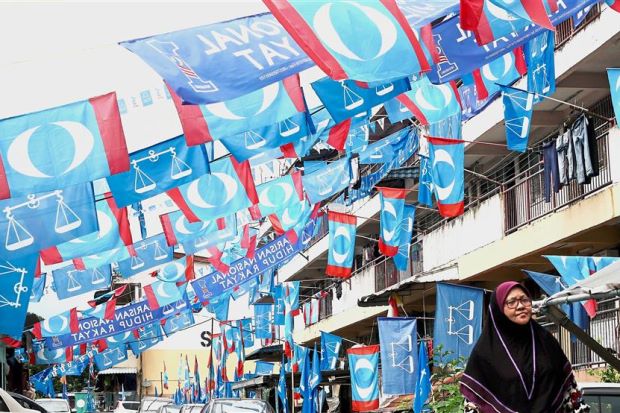
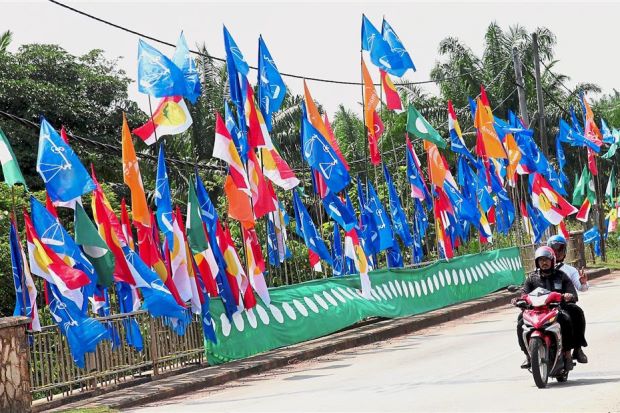
Flag war: Party flags of various colours have already been put up around the country in the buzz for the upcoming general election.

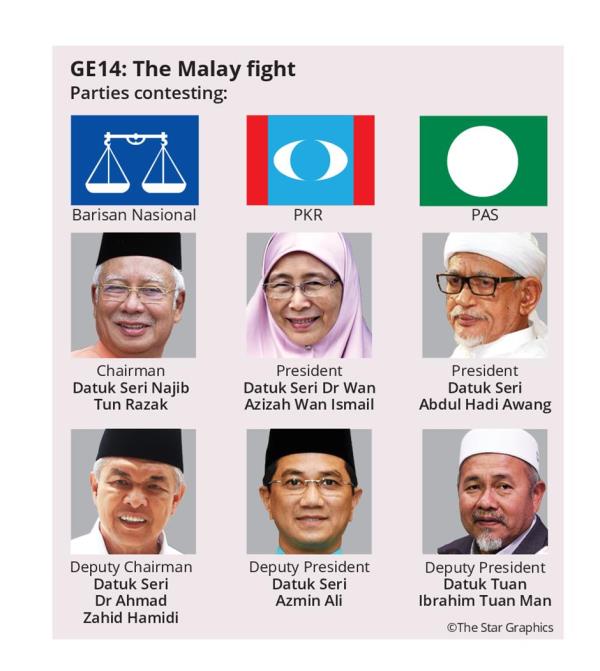
NO one, not even in his wildest dreams, would have imagined that Tun Dr Mahathir Mohamad would patch things up with his longtime nemesis, Datuk Seri Anwar Ibrahim.

And more incredibly, contest a general election on the PKR ticket.

The PKR symbol is, of course, the eye. Many of us remember the 1998 “Black Eye” incident, when the former deputy prime minister sported a badly bruised eye when he was brought to court after he was allegedly assaulted by the police.

Now here’s the former prime minister, who dismissed Anwar in the first place on grounds of sodomy and corruption, waving the PKR flag on a stage.

Anwar himself certainly couldn’t have imagined this would ever happen. Dr Mahathir even attempted to visit him in the slammer!

Then there’s former PAS leaders like Parti Amanah chief Mohamad Sabu, who gave hate speeches about Dr Mahathir, hurling disparaging remarks about his children’s wealth, but is now heaping praises on the former premier since they are all on the same turf.

It’s likewise with the DAP – its leaders have written voluminous books and churned out tons of videos about the former PM to discredit him, but are now singing a different tune.

The DAP, which urged Chinese voters to back PAS in the 2013 general election and painted the Islamist party as the most moderate party, is now saying the opposite. PAS is now being described as extremist.

Less than a year ago, the Chinese were angry with ultra Malay group Perkasa but now, many of them have donned the Pribumi uniforms and the party is cheered on by many Chinese voters, the very same people who criticised it previously.

Nothing is impossible in politics.

And why is a multiracial party like DAP contesting in Chinese-majority seats when Umno is their main “enemy”?

Why is MCA, a Chinese party, contesting in mixed seats with a Malay majority?

Also, why is PAS, the one-time nemesis of Umno, now on the friendliest terms and playing footsie?

No one is even sure if they drink from the same cup as they will contest against each other in the elections.

The two traditional rivals will surely slug it out in Kelantan, Terengganu and Kedah, even if Datuk Seri Najib Tun Razak and Datuk Seri Abdul Hadi Awang have been seen “flirting” in the political arena.

And even as they are facing off, it appears that Umno and PAS are quite prepared to help each other make up the numbers in case some unexpected scenario pops up.

Abdul Hadi talks openly of being kingmaker, and several PAS leaders haven’t dismissed the possibility of a Unity Government somewhere on the horizon.

After all, PAS was part of the Barisan Nasional when it was formed.

Under the late Tan Sri Asri Muda, PAS was a Barisan member from 1973 to 1978, and Asri became the Land and Rural Development Minister. He shifted PAS’ outlook towards Malay nationalism and moved away from the religious-based policy platform. But that made his popularity dip and he was subsequently ousted as PAS president.

The experience of having PAS in Barisan wasn’t a happy one and not long after, the party left the coalition.

It’s fair call to suggest the majority of the electorate want Umno and PAS to get together.

However, there are confusing and conflicting signals, making it difficult for grassroots members to make sense of it all.

For Chinese voters who are uncomfortable with Umno and PAS working together, they shouldn’t forget that DAP in fact, had worked with PAS, and many Chinese backed it in the last election.

It must have been confusing for us even after the Islamist party broke away from PKR and DAP. It was still kept intact in the Penang and Selangor state governments where its members were still state executive councillors for quite awhile.

Then there are disgruntled politicians who didn’t make the cut as candidates and openly threatening to sabotage their parties or counterparts from other parties! These characters seem to have forgotten that these parties don’t belong to their grandfathers, and it is not their given right to contest the elections.

Many proclaim that the main reason they took up politics is “to serve the people” but in the end, it’s apparent that they are more interested in serving their own selfish ambitions.

Then there are the gullible voters – they believe almost everything their political heroes tell them because they can no longer tell the difference between fact and fiction as they are blinded by emotion.

They forget that these politicians are always ready to strike a deal if it means making a difference to the balance of power, meaning positions, perks and power.

Of course, at their ceramah, some of them will be waxing eloquently about “political principles”, all with straight faces.

It would be naive of voters to believe that these politicians are more interested in saving the country or race, as their track record shows that it’s about saving themselves, their parties, their children and themselves.

A few are serial political nomads, who jump from state to state to contest, while others, who happen to be born in a particular state and grew up in Kuala Lumpur, and are now back in their home state, claim it’s a “home coming” for them when they don’t even know their way around town.

But, of course, over the next few weeks of the campaign period, we will see politicians of all shades telling us what they are doing is all for our sake.

Many of us will lap up these claims, spending time sending unsoli­cited political messages – inclu­ding fake news – via WhatsApp to acquaintances and, worse, straining friendships and family ties when they don’t echo our political enthusiasm.

I should only say this: Let’s try getting an appointment with the new Yang Berhormats once the general election is over. See if these newly crowned YBs still remember you. Good luck.

Much more than worlds apart

Rural challenge: For the people of Banggi in Sabah, picking up provisions means having to travel by boat on a four-hour journey through choppy open sea to the nearest town of Kudat.

TWO of our most naturally beautiful states, Sabah and Sarawak, are shockingly only an electronic visual experience to many peninsula Malaysians, viewed through their devices and little else. Few of them have set foot there, and if they have, they would likely have moved in and around the more administrative and commercial cities like Kuching, Kota Kinabalu, Sandakan, Sibu and Miri, and not some of the more remote locations.

It’s unlikely they would have subjected themselves to the rough terrains of the interiors, where one has to fly, travel upriver by boat and then hike through the jungles to reach the village settlements in these sprawling rainforests.

For some Sabah MPs, a 150km journey (the distance between Kuala Lumpur and Melaka, which takes 90 minutes for travel by road) into their kawasan could take six hours on muddy and slippery roads.

But would our Semenanjung folk even be aware that for the people of Banggi in Sabah, the biggest island in Malaysia, picking up provisions means having to travel by boat on a four-hour journey through choppy open sea to the nearest town of Kudat? If that sounds daunting, don’t forget the return journey.

This is something most people in Semenanjung cannot fathom. For us urbanites, that same chore merely means driving down the road to the nearest grocer. Given these geographical differences, people here speak nonsense when they talk about lopsided parliamentary constituencies.

The standard argument in every election is it being unfair for urban parliamentary seats, with its huge electorate, to have so few seats, while rural areas have more parliamentary seats. The suggestion here is that these purportedly lopsided situations are created to benefit the ruling party.

Without doubt, the rural heartland has always backed the ruling Barisan Nasional. But there is basis to this.

Take, for example, Sarawak, the Baram parliamentary seat. Let’s be honest: who would dare try to pinpoint its location on a map? It’s ok, you’re in good company. But look it up.

Baram is almost as big as Pahang, yet the state has 14 parliamentary and 42 state seats.

As far as the Baram voters are concerned, it isn’t fair that they are served by a sole MP and two state assemblymen. Prod them on the subject and they will tell you in the face that “Orang Malaya” (people of peninsula) talk rubbish.

Baram belongs to a remote part of Sarawak and is home to the Orang Ulu, a collective including the Kayan, Kenyah, Saban, Punan, Berawan, Lun Bawang and Kelabit. Many of us living it up in the city don’t even know of their existence.

The great Baram river, the second longest in Sarawak, flows through this landscape and is regarded as the lifeline of the indigenous people living there.

MPs in similar constituencies spend days, sometimes weeks, to reach small villages scattered in these huge areas. Certainly, urban MPs, albeit with a bigger electorate, have it easier than their counterparts in rural places.

Sarawak PKR chief Baru Bian has called for more parliamentary seats in the state, even if peninsula-based parties continue debating the suggestion.

Currently, Sarawak, which is almost as big as the entire Peninsular Malaysia, has only 31 parliamentary and 71 state seats.

In comparison, the peninsula has 166 parliamentary seats. Sabah has 25 parliamentary seats.

Baru said: “Sarawak is clearly under-represented, especially those in the rural areas.”

Then, there is Hulu Rajang, Malaysia’s largest parliamentary constituency. At 31,817sq km, it is about the size of Pahang. The state seats are Baleh, Belaga and Murum.

The electorate comprises only 7,000 Orang Ulu voters as well as 10,000 Iban. The 2% Malay/Melanau and 1% Chinese complete the 17,696-strong electorate. However, the sheer size of this seat is simply unimaginable to the average “Orang Malaya”.

The Kapit division in the central region is also the size of Pahang, though it has a population of only 18,000. The singular way to get there is by boat or helicopter.

This is Sarawak. It is complex, with its diverse cultural, racial and religious beliefs involving more than 40 ethnic and sub-ethnic groups.

More than 5,000 villages are distributed across a state the size of the entire peninsula with a population of only 2.6 million people. For campaigners in the elections, this means using four-wheel drives, long boats, speed boats, helicopters and trekking to reach there.

On the other hand, despite Sabah (73,620sq km) equalling the land mass of nine states in the peninsula and being 90 times the size of Perlis (816sq km), the state only has 25 parliamentary seats.

The rural Kuamut state constituency (under Tongod district) is 10,054sq km, which is larger than Kedah (9,347sq km), and the Keningau parliamentary seat is 3,533sq km, which is bigger than the combined 3,405sq km areas of Melaka (1,650sq km), Penang (1,039sq km) and Perlis (816sq km).

Kedah has 15 MPs, 36 assemblymen and one Mentri Besar while Kuamut is only represented by an assemblyman and shares its MP with Sukau (6,604sq km), which is about the size of Negri Sembilan (6,633sq km), with eight MPs and 36 assemblymen – a grouse veteran Sabah politician Datuk Dr Jeffrey Kitingan always points out.

The Keningau parliamentary seat, held by PBS chief Tan Sri Joseph Pairin Kitingan, for example, is larger than the combined states of Melaka, Penang and Perlis.

Keningau has only one MP and three assemblymen, while the three peninsula states combined are represented by 26 MPs and 83 assemblymen, two chief ministers and one Mentri Besar.

Basically, the MPs in these huge constituencies have to work much harder than their counterparts in the peninsula, even though they have fewer voters, given the nightmarish logistics involved.

Armchair critics sitting in the comfort of their homes and waxing critical eloquence about unfair parliamentary sizes, should try visiting these deep recesses to understand and better appreciate what these rural MPs need to contend with. It is no walk in the park.