Author Archives: wcw

Oh, we’re so gullible

Criminals are all coming to Malaysia and we seem to be easy pickings for the con artists.

WORD must have gone out to criminals all over the world that Malaysians are easily some of the most gullible people around. In their lingo, they probably say we are suckers, and what is sad is they are right.

There is also the perception that Malaysia’s international entry points allow for easy and unimpeded access to criminals and foreigners who come here not as tourists but for suspicious activities.

We also seem to be easily taken in by those who are white, or seem to look white, and believe they are all respectable well-off individuals, never mind that they come from financially stricken European countries.

A few may believe they also have better genetic stock, if we believe the stories from that bald Bosnian who also thinks he is good-looking and of great intellect.

But when it comes to con jobs, colour does not really matter. The con artists from Nigeria, who probably award diplomas for scams and other con jobs, have swindled many not only here but around the world too.

A few years ago, there was this con job where the perpetrators would convince a targeted victim to believe that the piles of bank­note-sized paper in a trunk or a safe were real money which had been dyed black or another colour supposedly to prevent detection by Customs.

The victim was then persuaded to pay for special chemicals to wash the “money” with a promise that he would share in the proceeds. The best part is that there were enough Malaysians, greedy and mental ones, who bought into this ridiculous scam.

And with the Internet boom, we started to get those outrageous e-mail from long-lost relatives of some corrupt civil servants, sometimes claiming to be from Zimbabwe, who want us to invest in some questionable deals. We would be promised a hefty commission to help the scums who supposedly could not take the money out of their country.

But this approach appears to be over-used now as even the most naive Malaysians are not buying into these silly cheating scams. So the African con men have re-invented themselves.

You have to credit them for their innovation. Outrageous as it may sound, they have taken on new identities as white men residing in the United States or Britain.

I can’t fathom how an African guy staying in a rented flat in Sentul can pass off as a suave, witty and charming Hugh Grant with impeccable English and a Chelsea address.

But each year, millions of ringgit go into their dirty hands because our gullible women, despite meeting these scoundrels via the Internet, never ask to talk to them and see them face to face via Skype or Face Time. It seems the sound of their voice is good enough.

It doesn’t matter that many of these African con men cannot even write well in English, but then many Malaysians also cannot do this now anyway!

According to says.com, “Malaysia is worse than Mexico in cyber crime. According to Sophos Security Threat Report 2013, Malaysia is the sixth most vulnerable to cyber crime.”

It said that listed among the 10 riskiest countries, Malaysia is also reported to be highly exposed to cyber crime with a reported RM1bil lost.

Then there are the Iranians. There are lots of Iranians in Kuala Lumpur and many of us can’t tell if they are rich oil sheikhs or drug smugglers.

The media is also filled with reports of Malaysian women who end up as mules for criminals who duped them to smuggle drugs – and all these women claimed they believed they were given free tickets to go on a paid holiday but had to pass the bag to someone while on transit.

Lately, we have South Americans entering Malaysia to target the homes of Malaysians. My brother walked into his home one day to find Latino-speaking individuals ransacking his house. Have we come to that?

Yes, they are all coming to Malaysia – the South Americans, the Nigerians and other Africans, and the Iranians.

As one writer, Norman Sukumaran, correctly said in the blog “OutSyed The Box”, “We have lost the fight against Indonesian overstayers and illegals, (but we) cannot now become a haven for Africans, Iranians and South Americans whose sole purpose to enter Malaysia is for criminal purposes.”

These criminals have given their countries a bad name and their decent, hardworking fellowmen who are students and professionals have found themselves lumped into the same category.

But who can blame Malaysians for feeling this way? We are already sick and tired of local hoodlums and the last thing we need are foreign criminals targeting us too.

Grand Old Man of Penang

Yeap family home: The Homestead in Jalan Sultan Ahmad Shah, Penang in 1984.

Yeap family home: The Homestead in Jalan Sultan Ahmad Shah, Penang in 1984.

A SERIES on the roads of Penang would not be complete, even considered unjust, without the mention of Jalan Yeap Chor Ee.

Yeap was known as The Grand Old Man of Penang.

His was a classic story of an immigrant who came from China penniless but worked hard to become one of the richest men in Penang of his time.

Stories of what we termed as Old Money would eventually become a memory of the past.

Yeap Chor Ee was a businessman, philanthropist, banker, commodity dealer, land owner, community leader and educationist.

In short, he had his fingers everywhere.

According to a report, he arrived in Penang, off a boat from Nan An, Fujian, China at the mere age of 17, with “little money and big dreams.”

He started his life in George Town, then a bustling port city, as a barber’s assistant.

Older Penangites, in their 80s, still recall his nickname as Thi Thau Ee or Barber Ee.

He was supposedly quite deft with his hands and plaiting the pony tails or towchang of the Chinese immigrants was a specialty.

Centre of education: Yeap's

Centre of education: Yeap’s ‘Homestead’ is now Wawasan Open University.

After five years, the entrepreneur in him saw Yeap working his way up to start his own provisions shop – which he named Ban Hin Lee or a “ten thousand flourishing profits” – at the age of 24.

His business grew from sugar trading to other commodities including rubber, rice, tin, tapioca and coconut oil.

According to one report, it was his association with Java’s sugar king, Oei Tiong Ham, that led him to eventually control a significant share of Malaya’s sugar market.

As a natural fit to his trading business, Yeap set up a financing arm in 1918.

By 1935, the business had grown so big that he incorporated the Ban Hin Lee Bank – the state’s first home grown bank, with its headquarters at Beach Street, the financial district of Penang.

Until today, he remains the only individual in peninsular Malaysia and Singapore to single-handedly fund the setting up of a bank.

He married a local girl, Lee Cheng Kin, and they had two sons, Datuk Yeap Hock Hoe and Yeap Hock Hin.

One for the album: Yeap Chor Ee posing for the camera.

Yeap posing for the camera.

Everyone in Penang knew where they stayed, an elegant mansion called Homestead – at 54, Northam Road – on what was then known as the Millionaires’ Row.

Northam Road, which is called Ang More Lor (White Men’s Road), has been renamed as Jalan Sultan Ahmad Shah and many of the mansions that belonged to the millionaires back then still stand, although some are now used for commercial purposes.

The area has seen much development over the years, with high-rise buildings coming up, which has taken away much of the grandeur of the past.

Despite his lack of education, Yeap understood the importance of teaching the young to read and write.

He supported institutions and set up several charitable trusts just before his death in 1952 at the age of 85.

By then he was known as The Grand Old Man of Penang.

Today, Homestead has been donated to the Wawasan Education Foundation, which has led to the setting up of the Wawasan Open University, the country’s first private non-profit university.

Educational philanthropist: Yeap, aged 83, in 1950 handing a

Yeap, aged 83, in 1950 handing a “princely gift” of $100,000” to then British Commissioner-General for Southeast Asia Malcolm MacDonald as a donation to University Malaya.

Of course, the Yeap family also owns other properties in the state, including a row of nine shoplots in Penang Street and King Street which have since been converted into the Yeap Chor Ee memorial museum stretching from Penang Street to King Street.

The museum showcases, among others, photographs of the interior decoration of the historical Homestead.

Interestingly enough, the road named after Yeap is nowhere near his points of greatest influence within George Town itself, be it near his residence or the bank he set up.

Instead, Jalan Yeap Chor Ee, named in honour of this great man, is on the other side of the island.

The road connects Green Lane, now called Jalan Masjid Negeri, to Jalan Bukit Gambir and Jalan Lembah.

This quiet neighbourhood link road has since become quite a busy road as traffic continues to grow on this part of the island.

On a personal side, my wife, Teh Tsui Ling, worked at the Ban Hin Lee bank headquarters in Beach Street for 11 years.

She was introduced to me by a colleague, senior editor Lim Cheng Hoe, who used to work with her at the bank.

The first time I saw her was at the nearby Komtar food court.

Heritage building: The old Ban Hin Lee head quarters is now a  CIMB Bank.

The old Ban Hin Lee headquarters is now a CIMB Bank.

My wife continued working with the bank at its Petaling Jaya and Kuala Lumpur branch when we moved down to the Klang Valley after we got married.

Ban Hin Lee Bank merged with Southern Bank in 2000 before SBB was taken over by CIMB in 2006.

Many who worked with the original Ban Hin Lee Bank have fond memories of its very personal approach to banking in line with its founder’s philosophy.

Officers recall visiting clients, many of whom have rags-to-riches stories like Yeap, at a very personal level over a cup of coffee to accompany them to the bank, carrying huge sums of money in paper bags.

In memory: Yeap's statue was unveiled infront of his old house, the

Yeap’s statue was unveiled in front of his old house, the “Homestead” in 2007.

Another interesting snippet about the bank’s headquarters, which is now a heritage building, is that it housed the office of the first Chief Minister of Penang, the late Tan Sri Wong Pow Nee.

For visitors entering Penang via the ferry, this iconic building is one of the first they see as the ferry heads towards the island.

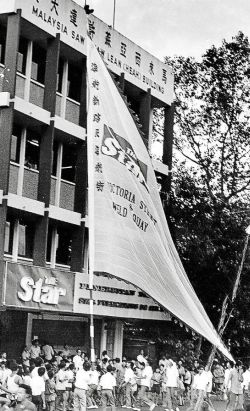
My connection to the Yeap family took an interesting turn recently when The Star refurbished its Penang Star office building in Pitt Street, now called Jalan Masjid Kapitan Keling.

The 107-year-old heritage building, where I first started work as a rookie reporter, is now home to the Penang Philharmonic Orchestra, comprising the most talented musicians in the state.

And the chairman of the PPO is Datin Seri Irene Yeap, an architect by training, who is the wife of Datuk Seri Stephen Yeap Leong Huat, Yeap’s eldest grandson.

The story of Yeap Chor Ee and his legacy will live on forever in Penang, deservingly for sure.

Hysterical hostility

Some of our politicians seem to be seeing shadows behind everything where there is none. From their perspective, there is intrigue, a hidden agenda and suspicious motives everywhere.

THERE seems to be no end to politicking in Malaysia. We thought the campaigning that reached its peak in the run-up to the general election in May would slowly wind down once the people had decided. But that was only wishful thinking.

We still are in election mode, judging by the endless bickering, growing suspicion over what everyone is saying, and the perception of a hidden agenda behind each issue.

After the polls, there were more ceramah and protests. Taking disputes to the courts was not enough in the battle to conquer the court of public opinion. And we all thought, naively, that everyone would just take a breather.

We all suffer from political fatigue. To be blunt, most of us probably feel nauseated. Surely the politicians, who are humans too, would want to get a break and make up for lost time with their spouses and family members. But no, they can’t seem to stop.

Everyone is talking about crime, the increase in the cost of living and the looming financial slowdown.

Well, we are also talking about Bosnian sperm.

But there seems to be a wide disconnect between our lives and that of our politicians, regardless of their political affiliation.

We do not see any of them explaining to us why our ringgit is weakening and how we should face the problems, even if there are external factors beyond our control. Those with children studying overseas are probably watching the exchange rates with eagle eyes and they certainly want to know what the future will hold.

Malaysians would also like to hear how we should gear up for the softening market as businessmen grapple with escalating costs and declining revenue and profits. It is not just a worry for those who run companies but also for their workers.

Instead, politicians are trying to outdo one another, trying to score points by making some pretty outrageous demands just to get their name and pictures in the media.

The main political parties in the country’s ruling coalition – Umno, the MCA and the MIC – are all holding their party polls very soon. PAS is having its internal polls too while the DAP is conducting a fresh election after its earlier vote tally blunder, which it continues to blame on a technical glitch.

In the case of the three main Barisan Nasional parties, we are talking about elections at all levels – from the branches to the divisions right to the top hierarchy.

We are pretty sure, judging from the activities on the ground and the desperate insecurity demonstrated by some politicians, that they are not doing much these days except to ensure their party positions are secured, or to get back a position.

Many have attempted to be champion spokesmen of their communities, flexing their political muscle, with some espousing views that smack with racial overtones.

Even the movies are not spared as politicians make laughable statements when they have not even watched the films and are unlikely to do so. But speak they must, and so they do.

Some of our politicians seem to be seeing shadows behind everything where there is none. From their perspective, there is intrigue, a hidden agenda and suspicious motives everywhere.

Reaction to the movie Tanda Putera is one example. The hysterical hostility towards the movie is unbelievable. I was among the earliest to be invited by Datuk Shuhaimi Baba, the director, to watch the show and to give my views.

I told her there should be more films like this because the world is beginning to think that we only watch movies about gangsters, ghosts and wife-beating husbands.

In Tanda Putera, the Chinese were not blamed for the riots but the communists and political activists were. This is the big difference which the politicians do not want to understand.

So is the unnerving reaction to The New Village. It is a period movie about new villages set in 1949, when most of us were not even born and the country was caught in a fight with the communists. We are now in the year 2013, yet we are still grappling with the ghosts of the past!

The communists in China have all become capitalists, drinking fine French wine, enrolling their kids in British boarding schools, keeping mistresses and becoming corrupt, as ordinary politicians in a democratic system do!

The only thing commie about the ruling elite in Beijing now is that they still carry party membership cards and uphold the red ideology to avoid a real election! Anything else red would be red wine and Manchester United.

We are still unsure if The New Village will ever make it to our cinemas. After all the party polls are over, perhaps.

Maybe by Christmas, although by then it would really be good luck to the producer because who would care about new villages in December and January as many of us would want to go on holidays and celebrate the year-end!

The holiday season is all about parties – celebratory ones, not political parties – and we just want to be silly, more than some politicians, as we usher in the coming year.

And we really hope that in the coming year, we will finally see the end to mindless politicking.

And can we please appeal to our politicians that they remember why we voted them in – to run the country, make us feel safe, plug financial leakages, seriously fight graft, postpone expensive projects and, if possible, stop using taxpayers money to put your faces on billboards?

Jelutong: Home to a thriving coastal village

Penangites regard Jelutong as a main road to the Jelutong suburb. — Zhafaran Nasib / The Star

Penangites regard Jelutong as a main road to the Jelutong suburb. — Zhafaran Nasib / The Star

TO THE Penangites of today, Jelutong is simply a main road to the Jelutong suburb. It is also simply the expressway connecting George Town to Bayan Lepas, though the Jelutong Expressway is now renamed the Tun Dr Lim Chong Eu Expressway.

In terms of publicity from a wider national perspective, Jelutong is also identified with outspoken lawyer-politician Karpal Singh who came to be known as the Lion of Jelutong. Sometimes, he is also referred to as Tiger.

Karpal, who saw himself as the voice of the mainly working class constituents in Jelutong, served as MP in the constituency for more than 20 years before losing the seat in 1999.

Jelutong was once regarded as a notorious area with gangsters and thugs, until the 1980s. It was surely one area many motorists passed by carefully, lest they knocked down a local resident. Apparently, street justice would be quickly meted out to anyone who broke the rules.


Jelutong Road: Jelutong was once regarded as a notorious area with gangsters and thugs, until the 1980s. — Penang Postcard Collection 1899-1930s

It did not help that another notorious area — Perak Lane — is a major road off Jelutong, with regular gangland fights and police raids.

But much of what the younger Penangites see of Jelutong today is vastly different from the Jelutong of old.

It was once a coastal village where the Jelutong tree or dyera costulata — which can grow up to 60m tall grew in abundance, hence the name.

There was a thriving fishing community and the mangrove swamps provided a good source of livelihood to many residents; not only for its fish and crabs, but as a source for the woodcutters and charcoal makers.

Bakau Street (Mangrove Street), a minor road off Jalan Jelutong, was the centre for the making of firewood and charcoal.

Kedai Kopi Tai Min along Jalan Jelutong with the nasi kandar stall adjoining the old building. 

Hugely popular: The family-run nasi kandar business (adjoining the building above) which operates at Kedai Kopi Tai Min on Jalan Jelutong is now run by Anwar Amir, whose grandfather sailed to then Malaya from India. — Filepic

Older residents also remember that fireflies were common in the area.

There is a different ambience today. The wooden houses with attap or zinc roofs soon gave way to high-rise buildings and shophouses although some residents have refused to give in to the growing tide of development. Along the busy main road, one can still see a soy sauce factory or two standing like a monument to the past.

My colleague, who once wrote about the six-room attap mansion that his family grew up in, would still tell stories about the bucket latrine system that was still present right up to the 1990s.

The family house has since been demolished and he was surprised, on a recent visit, to see that many old temples along the road have been demolished and the deities have now moved into modern-day dwellings.

In talking about Jelutong Road, another connection must surely be Sungai Pinang.

The first industrial boom in the late 19th century saw the expansion of supporting industries such as food-processing. The Khie Heng Bee Mills became one of the largest industrial concerns on the island. 

Nearby the city centre: The first industrial boom in the late 19th century saw the expansion of supporting industries such as food-processing. The Khie Heng Bee Mills became one of the largest industrial concerns on the island. — Streets of George Town, Penang

It is at Jelutong that this river meets the sea. For those of us in Penang who go swimming in the beaches of Batu Feringghi and Telok Bahang, Sungai Pinang, which begins as a pristine tributary in that part of the island is quite different once it reaches Jelutong.

When I was growing up in Penang in the 1970s, the river was terribly smelly. Today, it is still classified as a Class IV river with its water heavily polluted with residential, industrial and commercial liquid and solid waste.

Most of us saw the river simply as a large sewer then even though at that time, people would still hang around the area to buy fresh catch from fishermen returning from the sea.

It is hard to imagine that this estuary was once an active waterway used by the Acehnese, Malay and Indian traders.

According to the Penang Postcard Collection 1899-1930s by Khoo Salma Nasution and Malcolm Wade, located near the river mouth, there was a small resting place at the site of the present Masjid Maqbul.

“According to oral tradition, the Acehnese came to Penang before Light’s time and sold their wares in an open space called Teluk Jelutong, now called Kampung Pulau, at Perak Road,” they wrote, adding that villages flourished along the river.

The former Khie Heng Bee Mills building is still visible today, a reminder of the first industrial boom in the late 19th century, which saw white rice milled and boiled in large vats before being loaded on to boats, according to Khoo Salma.

There was even an “aerial tramway” or cable car, which was used to transport grain and copra between the drying area on one side and the mills near the waterfront, at the sprawling site.

This is the part of Jelutong that is close to the city centre but at the other end of the main road nearer to Gelugor, there is a different Jelutong.

Here, you still have the bustling Jelutong Market near the area where there is a big number of Malays and Indian Muslims.

This is why Jelutong is also home to the nasi kandar.

According to many Penangites, one of the best nasi kandar stores is the one operating at Kedai Kopi Tai Min, directly across the police station.

This newspaper previously report that the “Chinese coffeeshop in Jalan Jelutong is always brimming with a multi-racial breakfast crowd. It has been that way since the famous nasi kandar stall opened here some five decades ago”.

The family-run nasi kandar business is now run by Anwar Amir, whose grandfather sailed to then Malaya from India.

Interestingly enough, there is also a shop in Damansara Jaya named Restoran Syed Abu (Nasi Kandar Jelutong), a testimony to the popularity of the shop on the island.

In the old days, one has to go through Jelutong Road to get to Bayan Lepas and beyond but now most motorists bypass the main road and use the expressway instead.

Still, there is a quaintness about this part of Jelutong which is actually the beginning of Jelutong Road. Nearby is Bukit Dumbar, a reservoir buried beneath a hillock that was used as a picnic spot for the nearby schoolboys but as a lovers’ haunt by courting couples in the night.

And this is also where the Nicol David International Squash Centre is located.

Beauty of being Malaysian

While our nation is a country of endless possibilities, it is also a land of endless contradictions.

IT’S Merdeka Day. No Malaysian can possibly pass through the day (yesterday, to be precise) without a thought for our first Prime Minister Tunku Abdul Rahman.

That spellbinding image of Bapa Merdeka raising his right hand and leading the nation in shouting “Merdeka” seven times at the newly built Stadium Merdeka on Aug 31 1957 is etched forever in the minds of every Malaysian.

Nostalgia aside, I also wonder what the Tunku would have thought about the country and us, Malaysians, if he were alive today.

Yes, the slogan “Endless Possibilities” will soon be a buzzword but this is also a Land of Endless Contradictions.

But, as I wrote last week, I love these mind-boggling confusions. Malaysia is surely a more interesting place to live in than the clinically sterile Singapore.

Well, for starters, the Tunku would think we must have gone bonkers if we expect him to pester his Indonesian counterpart for help to ship in Indonesian maids and construction workers to Malaysia!

Bung Karno, as President Sukarno was called, would have freaked out and declared war on Malaysia, and not just a Confrontation!

But here we are, in 2013, and we expect Prime Minister Datuk Seri Najib Tun Razak to go to Jakarta, or any place where President Susilo Bambang Yudhoyono is present, to ask him if the maids are coming soon.

Here’s the weird part about us Malaysians. We whine and grumble that there are too many foreigners in this country and in the same breath, we complain that the government is slacking by not getting us enough foreign labour.

Now, we are launching a campaign to send the illegals back – and we all know full well that those we send back will return the following week.

We used to blame the foreigners for every single crime in this country and now we are also blaming them for voting the ruling coalition back to power.

So who do we blame for the spike in crime now? The poor Indians – someone has to be the scapegoat, and for good measure we also blame the Tamil movie industry with its violent plots for influencing this 1.7 million minority group in our country to turn to a life of crime.

But the Tunku would have loved the over 100 TV channels available today with most of them showing re-runs of muscular men wrestling with giant catfish and giant snakes.

In his days, there were only two channels although the TV sets came with many knobs to tune in to other channels.

The Sports Toto draw was aired live every Sunday afternoon with Faridah Merican, now Datuk, hosting the “cabutan”. Malaysians were so bored then that watching the drawing of numbers became routine on a lazy Sunday afternoon.

But the Tunku would have been perplexed by what is shown on TV these days, though with his open mind, he probably would have cracked a joke or two over it.

Scantily-clad dancers gyrating on Astro’s MTV channel are a given but when it comes to the newspapers, the rules are totally the opposite. In print, armpits and navels cannot be exposed, in case the images send some of us into a sexual frenzy!

Well, it may be hard for many of us to believe but this is the Land of Countless Contradictions, and the exposure of armpits, mind you, is definitely regarded as “terlalu menggairahkan” (too arousing). We have been lectured on this often enough.

I am also sure the Tunku would be howling with laughter at some of the ridiculous antics of our politicians.

The golden age of our local cinema movies was during the time of the Tunku when we had P. Ramlee, the Vespa, curry puff hairstyle and the pop yeh yeh at nightclubs. We are talking class here.

But now, we have relegated ourselves to watching local movies of gangsters and hantu (ghosts) while movie makers attempting to make serious, clever movies on history find themselves subjected to threats and bullying – by politicians who have not even watched their movies!

Here’s the best part! A movie about a rapist who beats up his wife and visits a nightclub, wins the best movie of the year award, with the leading character being almost hero-worshipped.

And that’s not all, the Singaporean actor also wins the best local actor award!

If you are confused, I don’t blame you, because many of us are confused, and that’s why we keep on doing confusing things.

That’s not all – the Tunku was always a football fan. This is the man who turned the Merdeka football tournament into a premier event in the region.

That was the best of the best. It was pure “gaya, mutu dan keunggulan” (style, quality and elegance), as a commercial from back then used to say. We beat the South Koreans, the Myanmars and practically any other foreign team that set foot on our soil.

Now, everybody can beat us. But no one at the Football Association of Malaysia is held responsible, even as the guys from the Maldives, who are trying to save their island from sinking, are ranked higher than us. Macam biasa aje, bro!

And if we talk about freedom, the Tunku would be floored because after 56 years of independence, lovesick Malaysian women are losing millions of ringgit each year to African Romeos posing as handsome and wealthy Englishmen.

It is simply incredible that these con men in Puchong or Sentul are able to convince our gullible ones that they are living in the English countryside and are looking for Malaysian love.

But don’t get me wrong! I love this country! I repeat, lest some super-sensitive politician makes an issue out of this column, I love this country.

Well, there’s one thing we consistently do very well at every Merdeka celebration – we produce the best TV commercials for these special occasions.

And most Malaysians still can laugh at ourselves, or at least at the politicians. Happy Merdeka Day!

Remembering Tunku

Loving family: Tunku Abdul Rahman with his family.On the left is Sharifah Intan.

Loving family: Tunku Abdul Rahman with his family.On the left is Sharifah Intan.

IT WOULD surely not be appropriate if a series on the streets of Penang and the origins of the names does not include the first Prime Minister of Malaysia Tunku Abdul Rahman – more so on National Day.

Tunku chose to retire in Penang and not the federal capital because he simply loved the island.

Although Tunku’s royal line was from the Kedah Sultanate, his connection to Penang came early, when he was sent by his mother, back in 1916, to be educated at the Penang Free School.

Ayer Rajah Road has been aptly renamed Jalan Tunku Abdul Rahman because he lived his last years in that leafy, affluent neighbourhood.

(Brief caption):PIC FOR WONG CHUN WAI. Jalan Tunku Abdul Rahman general view. /CHAN BOON KAI/THE STAR/(29th Aug 2013)

Tree-lined avenue: Leafy Jalan Tunku Abdul Rahman used to be known as Ayer Rajah Road.

The Tunku also had a bungalow along the beach front in Batu Feringghi.

The name Ayer Rajah was in reference to Teluk Ayer Rajah, a bay between George Town and Tanjung Tokong.

According to Penang writer Khoo Salma Nasution, by 1796, 10 years after Captain Francis Light founded Penang, over 2,000 acres of the area had been cleared.

As a rookie reporter in The Star’s Penang office in 1980, I had my first meeting with the Tunku at this residence.

I cannot remember clearly the date but, accompanied by a senior reporter, I was totalling in awe of meeting a living legend up close and personal.

Devoted family man: Tunku carrying great grandaughter Sharyn Lisa, Sharifah Intan’s daughter. With them are Sharifah Hanizah (in blue) and Tunku Khadijah.

Here was the person I have read about not only in the newspapers but also in my school textbooks.

At that point in time, he was not just a former prime minister but also the chairman of the board of directors of The Star. But it wouldn’t be right to say he was also my boss.

I was then waiting for my university entrance results. So my initial stint in The Star was short and only renewed four years later upon my graduation in 1984.

Meeting the Tunku became part of my regular beat.

I would head to the residence when he wanted to give a statement, or when he had visitors paying him a courtesy call. On such occasions, he would add value to the news reports by dispensing some advice, often on the need for moderation and for all the races to live together in harmony.

He had many visitors and they ranged from ordinary Malaysians to VVIPs.

Since some of the assignments were seen as having little news value, it was left to rookies like me to handle.

And the one message that came from him was simple, consistent and clear – all Malaysians must live in peace and harmony, and there’s no room for political and religious extremism.

Tunku was a man of another era. He was open about his love for horses and his trips to the Penang Turf Club were well documented.

His point of view: Tunku’s best articles from his column with The Star was handpicked for this book in 1971, and republished again in 2011.

The Star certainly owes much of its initial success and growth to Tunku. His column, Looking Back, which began in 1974, was featured every Monday, and quickly gained popularity and a loyal following.

His recollections of the fight for freedom enabled Malaysians to gain first-hand insights into the struggles and challenges that took place.

He may not be a historian but as a direct participant in our nation’s history, his writings were powerful.

Occasionally, I had to go to his house to collect his article, typed in huge letters by his secretary, owing to his diminishing eyesight.

He often used a magnifying glass to check the facts and spelling, before passing the articles to me.

Those were the days before the computer and the Internet.

As fate would have it, our two lives would inevitably be intertwined, no matter how minute, for a long time to come, and beyond his natural life.

In 2011 I wrote the foreword of the book, Looking Back – Monday Musings and Memories, which was a collection of his best columns.

The book was published by MPH Publishing and The Star.

The Tunku’s association with The Star was so strong that many believe, to this day, that Star stands for Suara Tunku Abdul Rahman.

I wish it is true, but it isn’t.

It was the paper’s founder K.S. Choong who selected the name for the newspaper which made its debut on Sept 9 1971 which was long before the Tunku came on board as chairman. But such a link is fated and we are thankful.

I am also fortunate to work with th Tunku’s grand daughter Sharifah Intan, a former deputy executive editor of The Star.

Sharifah’s daughter, Sharyn, is now a columnist with this newspaper.

I count it a privilege to have his family member as my colleagues.

Tunku’s cook, Salmiah Md Isa, who cooked for him for over 20 years, since she was 16 years old, is also a colleague at the Menara Star headquarters in Petaling Jaya.

She was originally hired as a nanny for Tunku’s children in 1968 but took over as a cook in 1970 when he retired in Penang.

The official cook in Kuala Lumpur did not want to join him in Penang and the job was suddenly entrusted to Salmiah.

Some of Tunku’s favourite dishes, she recalled, were ikan masin goreng, gulai Siam, kailan goreng belacan and, of course, curry, particularly fish curry.

Thanks to Salmiah, invited guests to The Star still get to enjoy some of Tunku’s favourites.

Tunku was a simple man who did not care about protocol.

He would sometimes go marketing at the Pulau Tikus market, located not far from his home, by himself.

He even dropped by a few times at my father’s roadside hardware stall in Cheapside, Chulia Street, instead of the many shops in the area which were more comfortable.

He told his bodyguard that he liked my father, who was born in Langkawi, because my dad could speak impeccable Malay with a Kedah accent.

I remember seeing the Tunku at his stall often when I was a boy.

As the nation celebrates National Day today, I must count my blessings to have been given the opportunity and honour of having met this great man.

A crazy kind of love

Despite our country’s imperfections – from imitation DVDs to politicians who don’t play politics to kopi-O drivers – we all still love Malaysia.

I LOVE Malaysia. It is truly a land of wonders and contradictions, and I think even our founding fathers would be, well, amazed if they were still around today.

We must be the only nation in the whole universe who watches pirated movies that start off with a notice from the distributor warning us why we should dump these imitations.

Behold, the quality is bad, the narrator alerts us in Chinese as we are shown two clips of the same car chase in a multi-storey car park, comparing the “imitation” with the “original”. And, of course, the super-duper quality movie we get to watch once this promo is over is still an illegal copy.

Then we have leaders, politicians and their family members who expect to be accorded VIP treatment all the time. They demand VIP passes from promoters of concerts so they can show off their status.

Funny, but many of us also demand the same VIP treatment ourselves, lapping up the VIP passes only to learn later that these so-called passes are no longer exclusive as there are hundreds of them.

I love Malaysia. We have thousands and thousands of Datuks, making this beloved land of ours the country with the most titled people in the world.

At the rate we are going, we will also top the list for having the highest number of honorary doctorate holders.

If you can’t get into medical school, it’s okay. Just buy a Dr title, whether online from a university somewhere in the south Pacific or approach a self-professed sultan from an obscure island off the Philippines. Almost everyone is now a Datuk Dr and nothing less.

For laughs, we know we can always count on our politicians. Malaysia again scores top points for politicians who regularly warn each other not to “play politics”.

As a journalist, I am confused by this. If politicians do not play politics, then what do they do? Play doctor? Play football, or simply play jester?

Recently, I came across a politician who accused this newspaper of instigating one politician against another. That’s a fresh angle to get attention at the expense of the media.

Since when have debates about our politicians, who are public figures, become private matters that the media should not report? Politicians are quarrelling all the time, anyway, or else they wouldn’t be politicians.

I also love our policemen. They deserve better. They are not the best paid in town and yet we expect them to be super heroes who work around the clock.

We expect our cops to be soft with our criminals, hug them, buy them dinner, play Candy Crush with them and give them massages, hoping that the scums would end up confessing their guilt.

Are these Malaysians who advocate such loving, tender touches for criminals really from our Malaysia, truly Asia?

As pressmen, we are also confused by the cops’ fondness of using certain terms at their press briefings. They love using terms like “certain quarters” or “pihak tertentu”. We must be the only country in the world that uses such a term. Why certain quarters, not half or three quarters?

Our cops also love playing at being diplomats. They will never say the criminals are from Indonesia, Thailand or Singapore. It’s always “negara jiran” or neighbouring countries, keeping the reporters guessing.

Are our policemen worried the mere mention of nationalities would spark off a major diplomatic war?

It’s even more confusing when the cops simply use the term “Africans”. Hello, that continent is really big, stretching from Timbuktu to Capetown.

They also seem to love using the words “we promise to get to the bottom of the case” and “we will not compromise”, but I suspect it’s the work of unimaginative reporters who use the cut-and-paste approach when filing their stories.

Here’s the best part. It’s almost a standard line among families of suspected criminals shot dead to declare that their relatives are victims of mistaken identity. They are their loved ones and they are angels, certainly not gangsters.

Really? Then why did everyone at the funerals carry swastikas and set off crackers, and why was the hearse adorned with wreaths shaped in numbers ranging from 04 to 08 to 36?

Malaysians have also become super sensitive these days. I don’t know if that’s the effect of the full moon but, for sure, it can’t be the recent meteor showers as that was a non-event.

We have become more religious, which is good, but our behaviour does not seem to correspond with our spirituality.

We deplore graft but we seem to think it’s okay to ask the driving instructor if it’s possible to “guarantee” a pass. A “kopi-O” licence is assured when we are prepared to part with some “duit kopi”.

And finally, we have now decided to play the national anthem at our cinemas. It’s long overdue. In fact, why isn’t the anthem played before football matches or any big sporting event?

Worse, there seems to be reluctance and uneasiness among some Malaysians over this move. These are the people who cannot understand that standing up at attention to sing the Negara Ku with gusto is to love Malaysia. It is not about loving the government of the day or a clarion call to join a political party.

So after 56 years of independence, many of us are still confused. Many are still caught up in a time warp, quarrelling over issues that should have been resolved or resolved in the 1950s. But for all its imperfections, we all still love Malaysia!

Zainul Abidin and his family are illustrious names in Penang’s history

Zainul was an old boy of Penang Free School and had his education there until Senior Cambridge. He then went on to teach at the school for 20 years. — filepic

Zainul was an old boy of Penang Free School and had his education there until Senior Cambridge. He then went on to teach at the school for 20 years. — filepic

HAJI S.M. Zainul Abidin, of which Jalan Zainal Abidin is named after, was no ordinary Malaysian. He was a teacher, politician, community writer and author.

Besides Jalan Yahudi, which has been renamed Jalan Zainal Abidin, a school in Hamilton Road and a block of flats in Jalan Perak have also been named in honour of him.

Jalan Zainal Abidin is a minor road in George Town, which runs from Macalister Road to Burmah Road and is parallel to Madras Lane and Lorong Selamat.

Zainul was an old boy of the Penang Free School (PFS) and had his education there until Senior Cambridge, which was a high achievement at that time.

Recopy pix of Ayer Itam

As head prefect for two years, Zainul was awarded the Medal of Merit by his principal Ralph Henry Pinhorn. — ‘Pengkisahan Riwayat Hidup Haji S.M. Zainul Abidin’

As head prefect for two years, Zainul was awarded the Medal of Merit by his principal Ralph Henry Pinhorn. In 1918, the then school head Harold Robinson Cheeseman offered him a job as a school teacher at PFS.

Pinhorn, with the colour blue, is one of the school houses at PFS. A road nearby the school is named after him. The current Chief Minister lives on that road.

Zainul went on to teach at that premier school for 20 years. He was actively involved in promoting cricket, football and judo. He was also a scouter.

Abidin’s fifth son put together the book pictured above to record the family history and contributions of his late father. — ‘Pengkisahan Riwayat Hidup Haji S.M. Zainul Abidin’

He taught geography, literature and even Latin and French, two languages which were offered to the students then.

Not satisfied with his academic achievement, Zainul went on to enrol in an off-campus course, where he became the first Malay to receive a Bachelor of Arts external degree from the University of London in 1933. By then, he already had six children.

The best known son, at least, to those of us in our 50s, has to be the late Datuk Zainal Alam, who was a senior RTM broadcaster. However, he was better known as an entertainer, singer and stand-up comedian.

The multi-lingual legend also wrote the country’s first Undilah song to encourage the people to vote in the 1955 election campaign. He was also the ring announcer for the Muhammad Ali-Joe Bugner boxing match at Stadium Merdeka in 1975.

Maliia Bakery located at Transfer Road. (Charles Mariasoosay - 25/07/2013)

Maliia Bakery in Transfer Road moved into the building previously occupied by Ismalia Bakery and brought with it a rich history of breadmaking. — CHARLES MARIASOOSAY / The Star

There are also other well-known personalities linked to the family. Zainul Abidin’s youngest sister, Shaharom Bee was married to S. Mohamed Ismail who set up Ismalia Bakery (now renamed Maliia Bakery) on Transfer Road.

The bakery is an institution in Penang known for its roti benggali.

By most accounts, roti benggali is actually a misnomer derived from two Tamil words: roti (bread) and penggalis (sharecroppers). It is said that Penangites in the early years of the 20th century mistook penggalis for Bengali and the name stuck, until today.

The most famous son of the bakery owner has to be former Court of Appeals judge Datuk Shaik Daud Ismail.

But it was Zainul Abidin’s active involvement in politics that earned him national prominence.

Kicker: Zainul Abidin's best known son, at least, to those in their 50s, has to be the late Datuk Zainul Alam (pictured), who was a senior RTM broadcaster, entertainer, singer and stand-up comedian.

Zainul Abidin’s best known son, has to be the late Datuk Zainal Alam, who was a senior RTM broadcaster, entertainer, singer and stand-up comedian. — filepic

At the Umno Malaya meeting in Penang on April 24, 1948, he was elected as the permanent chairman of the party. The meeting was chaired by the late Datuk Onn Jaafar at the Francis Light School, of which Zainul Abidin was then headmaster.

In 1955, Zainul Abidin’s first foray into Federal Elections started when Tunku Abdul Rahman picked him to contest the Barat Daya seat in Penang, where he polled 14,865 votes against independent Isa Sulaiman with 2,925 votes. The MCA candidate Chee Swee Ee, who was challenged by two others, won the Timur Laut seat with 7,253 votes.

His place in history has been correctly recognised with a road named after him, where he and his family actually lived.

Zainul Abidin passed away peacefully on Dec 8, 1969. His place in Penang and national history must be remembered.

His fifth son, Datuk Zainul Aziz, has put together a book in Bahasa Malaysia titled Pengkisahan Riwayat Hidup Haji S.M. Zainul Abidin to record the family history and more importantly, the contributions of his late father.

This writer, who earlier wrote about the origins of the Jews in Penang and how the road was named Jalan Yahudi (The Star, July 6), had wrongly attributed Jalan Zainal Abidin to the late Za’aba, one of the most respected Malaysian writers and Malay language experts, whose real name was Zainal Abidin Ahmad.

The Penang government should consider using the correct spelling of Zainul Abidin for the road to prevent future misunderstanding.

Spellbound by books

I love the smell of print. Call me old-fashioned if you must. Call me biased because I am in the newspaper business. Call me whatever you want, but reading is one of the simple pleasures in life that is still worth everything.

I READ at least four books at any one time and they are found in various spots of my house – from the bedroom to the living room to the most private room of all.

There are also books, magazines and newspapers in my car and in my office so I can catch up on my reading whenever I can.

I love the smell of print. Call me old-fashioned if you must. Call me biased because I am in the newspaper business. Call me whatever you want, but reading is one of the simple pleasures in life that is still worth every­thing. In the morning, all I need is a copy of the newspaper, two half-boiled eggs and a cup of Milo with condensed milk at a real kopitiam.

Despite the hype on e-books, I am sticking to well-thumbed pages instead of the touch screen. And I still love the crammed bookshelves in my private library, even if I have to struggle to look for a dust-covered book.

Those who have been to my house can see bookshelves at every floor and I am still adding books to my library. But compared to many other book lovers, I still have a long way to go.

The late Tan Sri Dr Tan Chee Khoon, whose life’s passion, other than being Mr Opposition, was reading, had an extensive collection of books on military history in his well-stocked library.

Former Kedah Mentri Besar Tan Sri Sanusi Junid, also another passionate reader, has a library with more than 20,000 books and I was given a tour of it when I interviewed him.

And our Prime Minister Datuk Seri Najib Tun Razak is an avid reader as well. Those who have been in the private section of his official residence will be suitably impressed by his extensive collection.

Those who argue that they can have more books on a PC than all these libraries combined do not know what they are talking about.

Horror writer Stephen King, in a recent video interview, said he could not imagine himself reading an e-book in his toilet. He said that if it accidentally fell into the toilet bowl, the device would be spoiled for sure. If it was a printed book, he would just fish it out, dry it under the sun and soon it would be as good as new.

He didn’t add that reading a real book, with the feel of the paper on the fingers, is like feeling an object of love. You appreciate the labour of love that goes into the writing. It just cannot be compared to flipping the pages on a tablet, even if the books are written by the greatest of writers.

Philosopher Alain de Botton, in an interview in the UK’s The Sunday Times, said “I am a recent apostate from e-books. I found that whatever I read on my Kindle, I couldn’t really remember in the long term. It was as if I had never read it.”

Well, here are the numbers: Amazon reportedly launched the UK store for its Kindle e-book reader three years ago and a frenzy of e-book buying followed. In 2011, sales grew by 366%, and the number doubled again last year when 65 million e-books were sold in the UK alone, making up 17% of the total book sales market.

The Fifty Shades of Grey erotic trilogy by E.L. James contributed much to the huge sales, filling the top three slots in last year’s e-book sales charts, the newspaper said.

But this year, growth is slowing, according to the newspaper, with sales expected to grow at around 20% only. The newspaper, however, did not give the figures for the sales of the printed versions.

But to put it in context, a report in The Telegraph in May, quoting the British Publishers Association, revealed that spending across printed and digital formats rose 4% to hit £3.3bil in 2012.

And printed books still accounted for the vast majority of sales, sliding by just 1% to £2.9bil. The share of the e-book market, although up by 134%, stood at only £216mil.

I am not sure about the situation in Malaysia although we are often reminded that reading is not a popular Malaysian pastime. A popular reference point has been on how, in 1995, Malaysians only read two books a year, though the statistics for 2010 showed that the number has increased to between eight and 10. Still, we have not done studies on reading trends that factor in e-books.

But if we look at the local bestsellers’ list published by the major bookstores, we can see that the ones that make the list are usually on management and autobiographies of rich businessmen!

Malaysians seem to prefer such dull reading materials to enrich themselves instead of heading to the fiction section to fire up their imagination. Well, at least something is being read.

Ironically, newspapers that thrive on sex scandals, ghost stories and other ridiculous gossip passed off as news seem to sell better these days, particularly in the vernacular press.

The thinking section of the newspaper, (like its Op-Ed section) that includes serious commentary on both the local and foreign fronts, normally do not have advertisements. The advertising fraternity is probably aware that readers are flipping past these pages, preferring to go straight to the news pages as well as the lifestyle, entertainment and sports sections. That’s popular culture and the real world, I guess.

Roaring times in old Air Itam

Sikh guards looking at the two remaining buildings - a pawn shop and a police station - which survived the Great Fire of 1935 in Ayer Itam.

Sikh guards looking at the two remaining buildings – a pawn shop and a police station – which survived the Great Fire of 1935 in Ayer Itam.

VERY few Penangites, I am sure, are aware that Air Itam used to have a swimming club and a zoo. Yes, you read it right.

The Eastern Garden Amusement Park was built in 1950 but it was shut down after several drowning incidents, and the popular park lost its lustre.

I managed to obtain a picture of the swimming pool at this park from the book, Glimpses of Old Penang, but there is little accompanying information.

The park was believed to be located at the foot of Penang Hill.

Then there is Zoo Road, named after the Penang Zoological Gardens sited there, which was supposedly built by a monk in the 1920s. The zoo had a collection of more than 10 types of animals and could well be the earliest zoo in the country.

A Rela member directing the traffic flow of at the Air Itam market on the eve of Chinese new Year

The Air Itam wet market area is a hive of activity daily, especially because of the popular asam laksa stall there. The asam laksa is said to be the best in Malaysia.

According to the book, published by The Star in conjunction with its 30th anniversary, the animals included tigers and lions, which were kept in separate artificial caves.

The rest of the zoo was landscaped with Chinese-styled decorative bridges spanning fish and lily ponds.

However, the zoo closed down before the Japanese Occupation because it became too expensive to maintain.

Zoo Road is a link road off the Jalan Air Itam main road. A Penang blogger correctly described Zoo Road as extremely fragmented.

“It is not possible to drive from one end of Zoo Road to the other,” the blogger wrote.

“The northernmost portion runs from Jalan Air Itam to end at Sungai Air Itam. The middle portion of Zoo Road emerges in Kampung Melayu.

“It connects with Jalan Pisang Embun near Lintang Zoo, and continues to the junction with Jalan Kampung Pisang, where it once again disappears. Zoo Road re-emerges the third and final time in Farlim, between Solok Zoo 1 and Jalan Ru 1, to end at Lebuhraya Thean Teik.”

Growing up in Jalan Kampung Melayu, I used to ride my bicycle through the myriad roads and lanes.

A young WCW posing on a car at his home in Jln Kampung Melayu in Air Itam - Recopy pix of Ayer Itam

The writer, as a young boy, posing on a car at his family home in Jalan Kampung Melayu, Air Itam, sometime in the 1960s.

Zoo Road is located two roads away from Jalan Kampung Melayu but I never knew there used to be a zoo there. It was set up by Fa Kong, a flamboyant monk. An inscription of Zen verses attributed to him can still be seen on the rock in the garden of the Kek Lok Si temple.

But the biggest story of old Air Itam — which got its name from the murky waters of the river that flowed through it, hitam or itam is Malay for black — was the big fire that razed the former rural village of attap huts and wooden houses to the ground in 1935.

WCW's mother, Yew Poh Choo, at their home in Jalan Kg Melayu - Recopy pix of Ayer Itam

The writer’s mother, Yeoh Poh Choo, watering plants at their home in Air Itam sometime in the 1960s.

According to Kwong Wah Jit Poh, the oldest existing Chinese daily in the country, the fire started at 1.25pm on Feb 3, which was Chinese New Year’s Day, when a gust of wind blew some burning incense papers onto the attap roof of a house opposite the police station.

By the time two fire engines arrived 45 minutes later, more than 100 homes were gutted, resulting in 1,000 people being made homeless and losses estimated at $200,000 (Straits Dollars) — certainly a huge loss at that time.

Only two buildings survived — a double-storey brick pawn shop and the small, wooden police station next to it.

Described as The Great Ayer Itam Fire, the many incidents of fire that plagued Penang and George Town since its founding in 1786 soon led to more fire-fighting brigades being formed and more equipment bought.

Water pressure in those early days was low and in one case, the firing of firecrackers “during a Chinese funeral ceremony almost led to the destruction of the Supreme Court and the Public Library in December 1916.”

According to the Straits Times issue of March 8, 1935, efforts to raise funds to help the victims through the Ayer Itam Relief Fund proved disappointing.

The fundraising activities included a football match between the Penang Chinese FA and Penang Mohammedan FC while Chinese tycoon Aw Boon Haw of Singapore donated $2,000.

Youth enjoying the swimming pool at the Eastern Garden Amusement Park in Ayer Itam in 1950. After several drownings. the popular park lost its lustre. - Recopy pix of Ayer Itam

Youth enjoying the swimming pool at the Eastern Garden Amusement Park in Ayer Itam in 1950. The popular park lost its lustre after several drowning incidents. — Pic taken from Glimpses of Penang

But the Straits Times reported in its April 18, 1948 issue that the fire in Ayer Itam had its good turn as a township of brick houses soon emerged with many people from George Town travelling to Ayer Itam — presumably at the present wet market — to shop on Sunday.

The population of Ayer Itam in 1947 was 13,468 people, according to the newspaper.

It reported that in the open market, “squirrels, puppies, turtles and monkeys fret in cages” were on display, adding an exotic touch to the place.

Penangites not familiar with the state’s history may be surprised at the existence of cinemas, amusement parks, clubs and even a zoo in old Penang. However, it has to be remembered that by the 1930s “more than 40 steamship lines connected Penang to the rest of the world, which make Penang one of the most important and busiest hubs in the region,” as one report said.

It was only natural that various kinds of entertainment could be found in Penang at that time, including cinemas, amusement parks and gambling establishments.

The Penang economy took a turn for the worse during the depression in the mid-19th century, but Air Itam continued to draw in local and foreign tourists because of the Kek Lok Si temple and Penang Hill.

But for Penangites like me, it is the popular asam laksa stall at the wet market, said to offer the best asam laksa in Malaysia, that pulls in the crowds.

I still make it a point to go back home to Jalan Kampung Melayu, where my parents still live, at least once a month. Air Itam, for me, is still home.