Author Archives: wcw

Be proud of our diversity

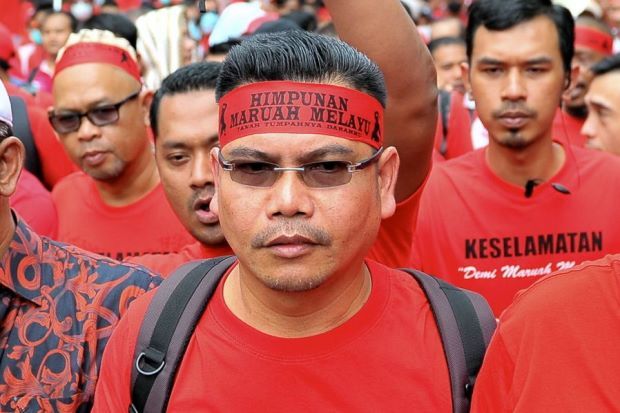
CONTROVERSIAL columnist Ridhuan Tee Abdullah, who has created a name for himself with his outrageous racist rantings ­rather than his academic achievements, found himself denied entry into Singapore recently.

He complained that he was “treated like a terrorist” and whined that his photograph and thumbprint were taken by the Singapore immigration authorities.

If he expected sympathy, he can be assured he is not getting any. Even those individuals and groups who would normally see this as an opportunity to take a dig at Singapore were silent. Only his misguided fans who share his fanaticism cried for him.

The incident took place at Singapore’s Woodlands immigration checkpoint, where Ridhuan said he was questioned for more than two hours and subsequently given a ­letter saying he would not be allowed to enter.

He seemed surprised at the action taken against him, saying “there was no reason given” but added that “I am confident that it was due to my comments on the ‘ultra kiasu’”.

Ridhuan has obviously chosen to forget that three years ago, he wrote in a Bahasa Malaysia newspaper, that “it is fortunate that I was not the PM when solving the dispute over Pulau Batu Puteh. If I were, I would definitely have not brought it to the International Court of Justice (ICJ).The only resolution to the dispute over the island is to wage war.”

If he expects the island republic to give him the red carpet welcome, then he really needs to see a shrink. If he complains about being treated like a terrorist, he has to look up the English language dictionary to find out the definition of someone who preaches the use of violence.

If he feels he can get any sympathy from moderate Malaysians with this latest incident, we think he is trying too hard.

Through his writings and public speeches, he has carved a reputation for himself to prove that he is more Malay than Malay and more Muslim than Muslim.

Ridhuan may want to think and dream like a Malay but he is still a Chinese. As I have said before, the fact remains that Ridhuan was given the name of Tee Chuan Seng by his parents at birth.

We do feel sorry for him sometimes, because he seems to suffer from an identity crisis problem. No matter how much he tries, the reality is that one cannot change one’s ethnicity. Even his religion does not require him to do so.

I am sure he understands that we are only here temporarily in this world. We will return to our Maker at some point.

We want to be remembered for our good deeds, regardless of our religion and race. Nobody wants to be remembered for making damaging, presumptuous and racist remarks.

And for all the anti-Singapore remarks that he has made, we would like to know why he was still interested in making a visit to Singapore.

Before he makes more disparaging racist remarks against Singapore, he should be reminded that he is also not welcomed in Sarawak. Early this year, he was barred from entering the state.

Bernama reported, quoting sources, that Chief Minister Tan Sri Adenan Satem was not in favour of the presence of Ridhuan in giving a talk at a mosque and had instructed that the event be cancelled.

Adenan had said previously that Sarawak was tightening its immigration rules and stepping up the scrutiny of visitors from the peninsula to keep out “extremists, religious bigots and racists”.

While people like Ridhuan may have a limited sphere of influence with his line of thinking, we can see the greater danger when prominent individuals of the world stage subscribe to such views.

Like the bigger bigot who is making world news daily – that orange man Donald Trump who is making a bid to get elected as the next US president.

It’s frightening really that a loose cannon like him could possibly be elected to the most powerful position on Earth and would have his fingers on the buttons to send out ­nuclear missiles.

Trump thinks that everything is like a business deal, a term he keeps using in his rallies, and he thinks he could just get people out if they don’t agree with him. His red-neck supporters simply eject his detractors out of his rallies.

He literally talks of building walls. Instead of bringing people together, like what a good leader should do, he has single-handedly divided the whole of America. He has spewed racist remarks against immigrants, even poking fun at how the Chinese speak at business talks, but forgets that his ancestors come from Germany, and that is well-­documented.

The trouble with some politicians is that when they choose to play the racial card, they conveniently forget about their ancestors.

They thump their chests, declaring their super pure racial stock, without batting an eyelid that there could be some traces of “other blood” from elsewhere.

Even in Malaysia, our past and present prime ministers all can trace their lineage to the land of Siam, the Bugis, Turks, Indians and Chinese, and some of our royalty have Western blood in them.

It is always much easier to play the racial and religious cards, enjoying the popularity of your own kind, without thinking of the long-term implications to the nation, especially one as diverse as ours.

To be a communal champion is much simpler than to be a leader of all. And politicians often take the easy route.

Advocating moderation is a long and lonely journey. It is not sexy and one can suffer from fatigue as the campaign seems to only attract the converts, particularly those in the urban areas. But those of us who have committed to the cause, including this writer, are not giving up.

Moderation is more relevant than ever in Malaysia and on the world stage. We want moderation to triumph, that’s for sure. We also want Donald to be trumped in his march to the White House. The American people hold the trump card in ensuring that moderation triumphs.

This is Malaysia. We are enormously proud of our multi-ethnic heritage and we must never allow any force to turn Malaysia into a mono-ethnic or mono-religious country.

Worse, some of us are even advocating that we embrace foreign culture in the name of religion or, in some superficial cases, pop culture. Please, we are not Arabs, Koreans or African-Americans. We are Malaysians.

Malaysians, like the Americans, hold the trump card, in charting the destiny of the nation.

The silent majority who value the peace and harmony of this nation where diversity is our strength must speak up to drown out the voices of those who seek to divide rather than to unite. That is our only hope.

I wish all Christian readers a Blessed Easter and I am thankful that my friends of other faiths have no issue greeting me likewise as they understand the significance of this day to people of my faith. Just like when I openly wish them when they celebrate their special days.

Time to cut the frills

Be it food, mementos or speeches, Malaysians need to learn to do away with unnecessary protocol and time-wasting practices.

A HOLDING room may not be familiar to many. But if you do a Google search, it can refer to a room that is located in a licensed facility for the storage or holding of dead human bodies prior to their being disposed. Well, that’s one meaning.

Another definition is that it is a place for candidates sitting for an examination to wait, before the test begins.

For hospitals, the holding room is where final preparations are made before the patient is wheeled into the operating theatre. Here is where he gets to meet the surgeon, the anaesthesia provider and other members of the surgical team.

Well, in Malaysia, the holding room is where the VIP – who is the guest of honour for an event – would spend barely 20 ­minutes before making the grand entrance into the hall.

The holding room, naturally, has to be paid by the organisers despite it being under-­utilised. There have also been instances when the VIP does not even want to be in the holding room because he is already late for the function or he does not care about such formality.

It is about time that Malaysian politicians encourage the organisers of such events to dispense with this silly practice.

I have had the opportunity to see first-hand how British Prime Minister David Cameron threw away such protocol by walking straight into the hall and making his presence simple.

London’s Mayor Boris Johnson is even better. He cycles to an event – without the fanfare and often arriving unannounced.

Last year, I attended the launch of a sales gallery of a housing project in a suburb in Sydney. The Malaysian developer and his staff waited respectfully for the mayor to arrive in an official car but he surprised them by walking to the function.

In Singapore, the Cabinet ministers are not judged by how many times their pictures or statements appear in the media but they are judged by their performances. Their informal style, without the need for the presence of an entourage of accompanying officers and party hangers-on, is well known.

Prime Minister Datuk Seri Najib Razak, in his blog posting on Feb 10, said expenses for official visits and events involving him and his Cabinet colleagues should be reduced in line with the Government’s austerity drive.

He mentioned that the organisers should avoid, wherever possible, red carpet welcomes, special meals and so on.

“Our main focus is the people, not protocol,” he said on his blog, NajibRazak.com.

This reminder is seriously long overdue but Malaysians want to see real action and not mere lip service. It will not be wrong to say that most Malaysians are generally tired of having to put up with the protocol involving politicians.

Such barriers do not help these leaders a single bit as it gives the impression, which the rakyat loathe, that they are special and must be treated special. More so when they constantly declare themselves as the people’s representatives. But they have to decide whether they wish to serve the rakyat or they want the rakyat to serve them.

And, of course, when can we do away with our 15-minute salutation of the special breed of Malaysians called “Tan Sri, Tan Sri, Puan Sri, Datuk Seri, Datuk Seri, Datin Seri, Datin Seri, Datuk Datuk dan Datin Datin” before it reaches the people who matter – the “tuan tuan dan puan puan”.

It may be a very Malaysian thing to be seen to be hospitable and appreciative by presenting a gift or a memento, as we like to call them here, at such events. But we know that most of these items end up collecting dust and are eventually disposed.

In short, these are items that the ­organisers should not spend money on. At one time, it was suggested that fruits be given instead, but it never caught on.

Works Minister Datuk Seri Fadillah Yusof must be commended for saying that his ­ministry has made it clear that no goodies are to be given to his staff, his deputy minister and himself during ministerial events.

“Even for all my working tours, we minimise or optimise cost by limiting the number of officers travelling and wherever we can, we cut cost,” he said, adding that he was more than happy to do away with protocol.

“I gave the instructions to my ministry and agencies when I became minister. Old habits die hard but slowly people are adjusting.”

Communications and Multimedia Minister Datuk Seri Salleh Said Keruak said the people should be able to have access to their respective leaders without too much red tape and bureaucracy, but most times, protocol gets in the way.

And this is not even Putrajaya but working visits by government leaders to various parts of the country to connect them to the people.

As what the Prime Minister said in the blog, Salleh reiterated that such working ­visits across the country must be about the people and not about protocol, red carpets and special meals.

We have to admit that food often takes centrestage at many such events graced by VIPs, whether organised by the public or private sector.

Malaysians like to treat their guests well and every function, even if not held over lunch or dinner, has a wide array of food served. We eat more than we should, as a result.

Most time this food is left unfinished and wasted. We only need three meals a day and really, anything in between should just be coffee, tea or plain water.

While cutting these frills may not save much, given the financial leakages that take place, the message we want to send out is that we must do away with unnecessary protocol and time-wasting practices.

Then there is more time to truly connect with the common people and listen to them. Such trips do not bring much benefit if it is just a one-way monologue. There must be genuine dialogue as these are rare opportunities when the rakyat can be that close to these leaders whose policies can have such an impact on them.

As has been said many a time, there are many good policies that have turned bad because of poor implementation. And the people on the ground are the best to tell the government leaders if that be the case.

But they have very little time to do so if they have to listen to long-winded introductions, sit through presentations of cendera­hati (mementos), and try and finish off the food. Not to mention the preparations before and the cleaning up after the event is over.

Politicking the Malaysian way

It’s all about politics now but sooner or later, healing the country’s bruised economy should take centre stage again.

THE unthinkable in Malaysian politics has taken place but it is mere wishful thinking if anyone believes that the Prime Minister is now in such a precarious position that he will now be forced to quit soon.

Datuk Seri Najib Tun Razak is certainly not in the most ideal position and certainly his image internationally has taken a beating but on the contrary, he has in fact strengthened his grip in the party.

Except for a few renegade divisions, most of the 191 divisions are solidly with him. So are the members of the powerful supreme council.

The branches that have come out to oppose Najib remain too insignificant to make any serious challenge.

By simple logic, the fact that Tun Dr Mahathir Mohamad and suspended deputy president Tan Sri Muhyiddin Yassin have to solicit the support of the opposition basically means that they could not muster the troops in Umno.

Dr Mahathir and Muyhiddin understand the politics of Umno well. They must have looked behind their backs and realised the harsh reality that not enough soldiers were with them.

Politics is a numbers game. It is also about power – the ability to reward and punish. If you don’t hold the power, then one can only promise hope but is unable to place the rewards on the table to win support.

By now, Muyhiddin and his loyalist, Datuk Seri Shafie Apdal, would have realised that their political lives have become much lonelier. There will be fewer calls and appointments now.

Despite the negative international press coverage against Najib, giving the impression that he is living on borrowed time, the Umno president has grown stronger internally and gone on the offensive.

The instruments of power are with him and he wields tremendous political clout now, with only loyalists in place.

Even in countries like the United States where there is supposedly a clear separation of power to keep the three branches of govern­ment – the Executive, Legislative and Judiciary – in check, the fact remains that it is the White House that determines most of the appointments.

That is why there is so much debate now on who President Barack Obama will name to the Supreme Court to take over from Justice Antonin Scalia, who passed away recently.

The head of government in all countries always make sure that Cabinet appointments and other key positions in the police and army are filled by people whose loyalty is assured.

This is the power of incumbency and even first year political science students would know that is how leaders work to ensure they are in command.

Removing Datuk Mukhriz Mahathir as Kedah Mentri Besar and suspending Muyhiddin is just the beginning.

A leader can only strike when he is in a strong position whereas the weak has to go on the defensive. In this case, Najib, who has been in politics for 40 years, has realised by now that nobody listens to a nice guy, who is often mistakenly regarded as weak.

The Cabinet’s decision on Friday to remove Dr Mahathir as Petronas adviser is not unexpected. Expect Najib to swing his axe further – as he removes those holding influential positions but have not supported him.

Najib’s continued hold in Umno and govern­ment is not determined by the Wall Street Journal or New York Times but by his party. Likewise, no one in Umno can remove Lim Kit Siang or Lim Guan Eng from DAP except DAP members.

But for all their political experiences, Dr Mahathir and Muhyiddin also committed a big blunder in seeking the support of DAP, which is unacceptable and even unforgivable in Malay politics.

Working with PAS, purportedly in the interest of the ummah, is politically acceptable. So too is flirting with PKR, as many PKR leaders were in Umno before.

But to sit next to DAP is a costly mistake for Dr Mahathir and Muhyiddin, and the former has now conceded that Umno members are unhappy with the association. But he has defended his actions, saying he has few choices.

Only one thing holds the unimaginable alliance together – to remove Najib over the 1MDB investment fund controversy.

The majority of Chinese voters, especially in the urban areas with their anti-­establishment sentiments, have little understanding of how the rural Malay heartland feels.

They are unable to grasp the intrinsic of Malay politics and due to wishful thinking, they have convinced themselves that the Malay electorate would rise up and join them in voting against Umno.

They cannot comprehend why the Malays in the rural heartland do not embrace and love DAP as they do.

Their benchmark of Malay support of the opposition is also PKR and they forget that PKR’s base is mainly the urban Malays, mostly in Selangor.

After giving their huge support to PAS in the 2013 elections, and having actually convinced themselves that PAS would never implement hudud, the Chinese voters are now coming to terms that PAS theologians have consistently said they want an Islamic state.

It’s just that in the election euphoria, the Chinese voters have chosen not to accept this political reality.

The absence of PAS among the opposition ranks does make a difference as is obvious from the Bersih4 rally and the Citizens Declaration event.

What is clear is that a big Malay opposition party isn’t taking on Najib, as what an opposition is supposed to do.

For Chinese voters who are angry with Umno, perhaps they should ponder this: What happens if the majority of Malays dump Umno and vote for PAS instead?

Think of the implications to Malaysia. As the saying goes, be careful what you wish for.

Malaysians are also still shaking their heads in disbelief that the man whom Dr Mahathir put in jail for sodomy has now come out to support his nemesis in his plan to topple Najib.

The situation can be considered bizarre but Dr Mahathir has transformed himself to be the de facto opposition leader, although he prefers to call it the citizens revolt.

The 90-year-old leader himself described the group of mostly retired politicians “as a very strange group of people”.

Most analysts who care to read Malaysian politics in a balanced and rational matter would agree that the group would be unable to topple Najib but the group can also cause damage to Barisan Nasional and Umno as they continue to chip away the armour.

It will be naïve if Umno leaders arrogantly dismiss this movement, which is certainly going to make its voice heard.

Yang Razali Kassim, a senior fellow with S.Rajaratnam School of Inter­national Studies (RSIS) at Nanyang Technological in Singapore, aptly wrote that “any misplaced sense of supreme confidence on the part of Umno could, however, backfire” and that “it would be foolhardy to take lightly what the 90-year-old warhorse is now doing, which may well lead to big changes in Malaysian politics”.

He warned of the impact to Barisan and Umno in the next general election, “if Dr Mahathir and his citizens’ movement grow, and the opposition recovers from its disunity”.

There’s never a boring day in Malaysian politics but the daily politicking could well take its toll further on the bruised Malaysian economy which needs the complete full attention of Najib.

Once a Penangite…

An aerial shot showing the flattened ancillary buildings at the Runnymede property in Jalan Sultan Ahmad Shah, Penang.

IT’S a fact that not all of Penang’s state government leaders are true-blue Penangites. Chief Minister Lim Guan Eng was born in Johor and spent his childhood in Malacca.

Deputy Chief Minister Dr P. Ramasamy is from Sitiawan before settling down in Selangor as a university professor.

Senior executive councillor Chow Kon Yeow is also from Selangor but, to his credit, he has spent more time in Penang because he studied at Universiti Sains Malaysia and started his working life in Penang.

Penang Gerakan chief Datuk Teng Chang Yeow, a former Penang state exco member, is Batu Pahat-born but also studied at USM and settled down in Penang.

There’s a lesson they would have learned by now – that Penang’s non-governmental organisations are among the most active in Malaysia. Correction – it’s among the most active in the world.

The concentration of NGOs in Penang is surely among the highest in Malaysia and we are not talking about one-man group with no records but NGOs which are organised with good track records.

The Consumers Association of Penang is surely the best organised in the country and it has a large workforce which runs the NGO effectively. The Friends of the Earth and the Third World Network are also linked to CAP leaders.

Penang’s civil society is vibrant and loud – and no state leader can afford to snub them if they know what’s good for them.

After all, the state is the only one which has kicked out every chief minister. The casualties are the late Tan Sri Wong Pow Nee (MCA), the late Tun Dr Lim Chong Eu (Gerakan) and Tan Sri Dr Koh Tsu Koon (Gerakan).

It also goes to show the independent streak of Penang voters. The results of ­previous elections have shown that voters do not simply mark a cross on the same party symbol for both state and federal seats. In the earlier polls before the political tsunami of 2008, it was not uncommon for them to vote a DAP candidate to Parliament while settling for a Barisan candidate at the state level.

Which is why DAP supremos like Lim Kit Siang and the late Karpal Singh have tasted defeat in Penang before.

Karpal, born in Penang, began his political career in 1970 when he joined DAP. He won a seat in the Kedah State Legislative Assembly in 1974. In 1978, he was elected MP for Jelutong, which he held for more than 20 years until losing it in 1999.

Kit Siang, on the other hand, has moved around the country a fair bit despite his Malacca roots. He made his entry into Penang by winning the parliamentary seat of Tanjong in 1986, defeating Koh Tsu Koon by a big majority. He retained the seat in 1990 and 1995. But in 1999, he stood in Bukit Bendera but was defeated by Gerakan’s Chia Kwang Chye by a narrow 104 votes. He also lost in the state seat of Kebun Bunga to Teng Hock Nan in that election.

At the state level, he clinched a momentous victory over Lim Chong Eu for the state seat of Padang Kota in 1990. But if he thought he was definitely welcomed in Penang, he was soundly defeated by Koh Tsu Koon in the 1995 election for the state seat of Tanjong Bungah. It was sweet revenge for the man he beat for a seat in Parliament in 1986.

Politicians who think Penang voters are die-hard party loyalists will learn soon enough that Penangites give much weight to the individual’s behaviour, regardless of party affiliation.

The voices of Penang civil society cannot be easily ignored, as they can influence the elections too.

From the protection of trees to conservation of heritage buildings to political consciousness, there is always a desire to be united, a desire for civic empowerment and rights-based action, as widely respected activist Datuk Anwar Fazal aptly puts it.

Long before moderation became a fashion­able word, the movement had taken shape under Aliran or the National Consciousness Movement under the leadership of Dr Chandra Muzaffar.

The former USM political scientist had already pushed for Malaysians to focus on common values instead of highlighting on their differences.

He led the NGO, which comprised many USM lecturers, for 14 years and what stood him apart from the other political commentators was his ability to analyse and explain national issues in a balanced and rational manner.

Always the educator, Dr Chandra has inspired many, including Penang-born prominent moderation activist Anas Zubedy, who is now the secretary-general of the International Movement for Just World, also founded by Dr Chandra.

In recent years, we have seen how a group of architects, communal landlords, environmentalists and historians have come ­together to form the Penang Heritage Trust.

Penangites have a history of fighting to save heritage buildings, including the failed attempt to rescue College General, a Catholic seminary that trained priests in Penang and Malaya for 176 years.

So, the state authorities can expect to face stiff protests if there are any attempts to cut down trees to widen one portion of Green Lane – or Jalan Mesjid Negri as it is known now.

Penangites will not be persuaded that these trees will not be destroyed but relocated. Let’s face it, we would sure like to know how the century-old grand old trees can be uprooted and relocated.

More recently, the Penang government also backed down from a purported move to acquire school land to expand Gottlieb Road.

A social media campaign “Save Penang Chinese Girls’ High School” was successfully launched and the anger has not abated despite reassuring words by Chow, with ­critics pointing out that state government leaders had given contradicting responses.

Penangites are also upset at the demolition of several buildings in the Runnymede proper­ty along Jalan Sultan Ahmad Shah recently. The buildings were on the site of Sir Stamford Raffles home in Penang.

Raffles, who went on to found Singapore, had worked under Sir Captain Francis Light in Penang before going to Singapore. He was assistant secretary to the governor of Penang in the early 1800s.

Penangites are enormously proud of their heritage – and while they want development, they also want to keep Penang as it is.

For older Penangites, who have lived through the times when Penang was physically better off, this is their last fight to keep the natural beauty of Penang.

They have seen how bad land reclamation has taken away their beach in Gurney Drive and what they see now is a large piece of ugly mudland during low tide.

Penangites are known to be independent-­minded, liberal, progressive, assertive and outspoken – they will come together for a common cause and, as one writer wrote, to “revitalise their sense of belonging”.

The NGOs of Penang have supported politi­cal parties who come to power and they have also worked against them when they do not keep to their side of the bargain.

Let no politician be mistaken and it’s best that they read up the history books on Penang’s dynamic civil movements.

In 1990, when Dr Lim proposed an extensive development plan for Penang Hill, NGOs such as PHT, CAP and others united to “Save Penang Hill” and condemned the plan’s environmental and cultural hazards. They ­organised sit-ins and directed as many as 3,000 spontaneous complaints to the Department of Environment.

As one report said, “Penang Hill being widely considered one of the island’s most important physical and cultural landmarks, the Hill incident attracted an unprecedented public outcry.

The battle to preserve the Hill became the key issue in the 1990 elections, costing Lim his state seat and ending his 21-year tenure as Chief Minister of Penang.”

There were, of course, other contributing factors but the point is that ideas of sustainable development, green policies and human rights have always been points of endearment among the Penangites, who can be counted upon to quickly organise themselves.

No one, especially politicians, should take for granted Penangites, as they fall in love quickly with politicians but also get into a fight just as quickly.

And let’s also not forget they can also count on the support of the Penang diaspora who are scattered all over the country, especially in the Klang Valley, and the world.

It has been said many a time that you can take a Penangite out of Penang, but you can never take Penang out of a Penangite. They have the power to influence, too.

A film that brought us together

‘OlaBola’ is a reminder to us that whether we win or lose in the pitch or elsewhere, we are in this standing side by side.

IT isn’t right at all but that is the harsh reality – Malaysians are craving for the past when we used to be better as a nation and as a people. Which is why the movie OlaBola has captivated the nation, hailed as “the ­finest local movie in living memory” by prominent journalist Tan Sri Johan Jaafar. 

Another veteran newsman Datuk Seri Azman Ujang finally made the effort to visit a cinema after 30 years just to watch it.

I finally found time to watch the movie last week, which is based on the true story of the football match between Malaysia and South Korea at Stadium Merdeka on April 6, 1980, where the winner would qualify for the Moscow Olympics that year.

For those of us who are past 50 years old, it brought back a flood of memories when, once upon a time, we could remember the names of all our national players.

As Azman correctly said in his article about the movie, we can no longer rattle off the names of the national squad.

I agree. It is indeed ironic that many of us can rattle off the difficult foreign-sounding names of our favourite Premier League clubs, yet don’t have a clue as to who is playing for the national team. Indeed, the team of 1980 left behind a ­legacy, as they promised themselves they would.

Those were indeed the days when Malay­sia was truly 1Malaysia without the need to shout the slogan. The national football team was not only truly multi-racial, but they played great football. The team beat South Korea but never made it to the Moscow Olympics though, as Malaysia joined the international boycott of the Games because of the Soviet invasion of Afghanistan.

It must also be mentioned here that the national teams before this team fictionalised in OlaBola also won the hearts of all Malaysians, especially the team which qualified, and played in the 1972 Munich Olympics. As a nation, it was also the good old days, when politics wasn’t racial even if the political parties were communal based.

It was a time when politicians did not need to proclaim themselves as champions of their races nor was it necessary for them to dress up to look religious and pious.

The heroes of 1980 were the super cool Soh Chin Aun aka Towkay, who was the captain, striker Mokhtar Dahari aka Super Mokh, and goalkeeper R. Arumugam aka Spiderman because of his long arms.

No one saw them as Chinese, Malay or Indian. No one would even question why a Chinese should be the captain of the Malaysian football team. They were just looked upon as Malaysians.

Today, the team is no longer multi-racial.  Whether there are no longer talents from the Chinese community, or whether this has come about because of our school system, the effect is that the multi-racial face of Malaysian football is gone.

So, many of us, who have seen the better part of Malaysia, must have also been rudely reminded that in our heyday, we beat Asian giant South Korea 2-1 in that vital match at Stadium Merdeka (in the movie, the scoreline was 3-2).

Today, at No.171 in the FIFA rankings, we are languishing with the likes of Bangladesh, Bhutan, Timor Leste, New Caledonia and Mauritius. We were also recently beaten to a pulp by Palestine in the World Cup qualifying match.

Interestingly enough, South Korea today has its players playing in top European football leagues. And incredibly, our current national ­players, who also play professional locally, earn six-figure salaries.

None has to hold clerical jobs with PKNS or JKR or TNB, as most of our past national players had to back then. The luckier ones were in the police force. 

But OlaBola isn’t the only movie that makes us nostalgic. Why is it that Malaysians never grow tired of watching  reruns of P. Ramlee movies?

It’s very simple – no Malaysian has been able to meet his standards. No one has been able to produce anything close to what he managed to do. 

His era reminded us about the days when things were a lot simpler, when we were just happy to live together as one nation.

It was a time – which would never happen again – when it was perfectly acceptable for a woman to hop on to a Vespa with her boyfriend and dance the night away while being serenaded by a band where the lead player played the saxophone. And she would be dressed in a nice body-hugging baju kebaya.

Today, if one were to make a movie like that, he would risk being attacked on social media by those who think they are the moral guardians of our society.

Surely P. Ramlee would never have imagined that one could be criticised for shaking the hand of a female and worse, that few would stand up to question the criticism.

OlaBola is surely the first Malaysian movie where all the major languages and dialects that are widely spoken by Malaysians are used. 

The movie has been able to spread the message of unity and patriotism without been seen to be forced or perceived as propa­ganda. However, it would have been more appropriate for it to be shown as the run-up to Merdeka Day or Malaysia Day instead of Chinese New Year.

I hope every member of the Cabinet would take two hours off and watch the movie. Likewise, too, members of the opposite side of the political divide.

I also hope Biro Tatanegara will make it compulsory for all participants to watch the movie instead of instilling racist fears and, certainly, Ali Tinju should be forced to watch the movie non-stop while under remand the next time.

Schools should be encouraged to screen the movie while clubs and non-governmental organisations should be encouraged to organise private screenings.

When OlaBola ended, there was huge applause from the audience – I feel truly good because it was spontaneous. 

I did not cry but I was certainly emotional because I had lived through the 70s and 80s, and watched the night when Malaysia beat South Korea, regarded as Malaysia’s ­proudest moment.

Azman recalled what retired sports journalist Tony Francis told him: “Even after 36 years, I could still break into tears watching the clip. What a night it was for the players and Malaysia.”

I never imagined that one day I would be able to meet these football legends up close. Thanks to His Royal Highness, the Sultan of Selangor, who picked me as a committee member of the Selangor Cup, I have been able to meet legends including the Towkay and Santokh Singh who still play for the state ­veterans annually.

At their age, they are no longer physically strong. They can only play for less than 20 minutes and, in some cases, less than that, but you see the Towkay dribbling the ball like he is doing the waltz. That magic touch and that magic moment for Malaysia is ever present.

The producers of OlaBola have been able to do for Malaysia what many politicians cannot do – to remind us that as a nation and as Malaysians, “kita menang sama-sama, kita kalah sama-sama” (we win together and we lose together).

Thank you, director Chiu Keng Guan, the cast and all in the crew for your invaluable efforts in bringing us together.

The migrant dilemma

It may not be possible to stop having foreign workers in Malaysia but we do need a systematic method to deal with them as long as we need them here.

MALAYSIANS have a love-hate relationship with migrant workers. We need them to support our industries but we are also uneasy with their presence.

We get upset with Putrajaya for planning to allow 1.5 million Bangladeshis to enter but employers are then furious when the Government announced a freeze on migrant labour.

Malaysians want them to do the menial work – the dirty, dangerous and difficult ones – which we hate to do ourselves but we do not want the presence of migrant workers amongst us at the same time.

We feel uneasy when they are around us because of their social and cultural differences and, let’s face it, some of us look down on them.

So, the Government ran into a perfect storm when it announced that it would sign a memorandum of understanding with Bangladesh to take in 1.5 million Bangla­deshis in stages over a period of three years.

It is a subject that has been widely discussed, even debated, in Parliament, and last week’s signing of the MoU was the climax to a subject that is known to most of us.

But there was an uproar when the deal was inked. It didn’t help when it was later explained that initial reports of having Bangladeshis brought in were untrue.

We were told that the figure consisted of Bangladeshis who had registered to work abroad and they would not necessarily come to Malaysia.

Not many Malaysians I know bought this line and it sounded like a poor attempt to play down a controversy.

Then, Deputy Prime Minister Datuk Seri Dr Zahid Hamid announced a total freeze on foreign workers for the time being. He urged all employers to recruit local workers instead.

He said the freeze was temporary until we are able to identify the exact needs of the various industries in the country.

No doubt that it may appear to be a flip-flop decision on the Government’s part but Zahid has done the right thing.

It’s time for the Government to take stock of the actual manpower needs of the various sectors in this country, especially with the economic slowdown.

It is necessary for Putrajaya to listen to the views of the stakeholders as well as ordinary Malaysians who generally feel that there are way too many migrant workers.

It is also perplexing to now hear business groups, which had earlier rapped the Government for agreeing to the inflow of Bangladeshi workers, suddenly criticising the temporary freeze.

Malaysians assume that the freeze involves only migrant workers because what Malaysians want to see are skilled and qualified expatriate workers. It is these affluent professionals that will bring much-needed skills to Malaysia.

But even at this level of workforce, there are specific needs in Malaysia, different from Singapore which is a financial hub and is able to attract the necessary professionals.

We are still a commodity-based country as well as a manufacturing centre. We need a different set of workers.

But there has to be a fine balance because a continued reliance on migrant workers, mostly unskilled and illiterate, would have a serious implication on Malaysia.

In the case of Bangladeshis, we were prepared to let their women come in as well.

The last thing we need are migrant ­workers starting their families here and we know that is already happening.

We may be happy to use cheap labour but there are hidden financial effects, especially on health and education, which will affect taxpayers in the end.

Let’s look at the statistics – the country’s 30 million population has about 20 million in the working age group of 15-64 and according to reports, only about 14 million are employed.

It can be assumed that some five to six million are in school, jobless or unable to find work or be employed.

Possibly, many have also decided to give up working, especially those above the age of 50, preferring to enjoy early retirement.

We are told that Malaysia has 2.1 million legal foreign workers, the Government said. Another 1.7 million foreigners are estimated to be working illegally in Malaysia as of December last year.

So we have about 3.8 million foreigners, and we are sure that does not include the huge number of illegals in Sabah in particular.

The country’s ethnic demography, based on 2010 census figures, comprises Malays (50%), Chinese (22.6%), indigenous (11.8%) and Indians (6.7%) while non-citizens account for 8.2%. In short, foreigners, especially non-citizens, have actually outnumbered the local Indian community.

We do not want Malaysia to be like Dubai, where its foreign workers are more than the local population.

But Zahid has rightly pointed out that our reliance on foreign labour must end if we want to stop having migrant workers in Malaysia.

We have a Catch-22 situation here where, from a business perspective, the cost of labour is low when foreign workers are employed.

Malaysians are not prepared to handle the dirty, dangerous and difficult jobs that these workers are prepared to do and employers are refusing to pay minimum wages to locals because they can reap bigger profits – in the name of remaining competitive.

But there is a need to instil in our young that there is no social stigma taking on less “glamorous” jobs so long as it is an honest day’s work. We have so many unemployed graduates who should consider trying out such options rather than wait for the right openings.

In the West, blue-collared workers are paid by the hour with compulsory tips that actually go into the pockets of the waiters, for example.

But in the long run, Malaysia needs a long-term plan to build up knowledge-based and value-added operations in all sectors.

Greater incentives, for example, must be given to manufacturers to introduce automation to end the dependence on unskilled labour.

It is unreasonable to stop having migrant workers but we need a more systematic method of dealing with them where we ­seriously take into account their years of stay in this country as well as the kind of limits we must implement to manage them.

Discourse vital in democracy

We don’t have to agree with each other but we must have meaningful discussions to have a healthy exchange of opinion. That’s how we learn.

FINALLY, we get to see some common sense and sanity. Malaysians certainly welcome the decision of Attorney-General Tan Sri Mohamed Apandi Ali in dropping the sedition charges against Dr Azmi Shahrom.

It’s better late than never. Enough time and energy have been wasted by the authorities and the Universiti Malaya law professor in having to deal with the charges.

Azmi is a law professor and he is expected to give his opinion on legal issues. That is what lawyers and law professors do.

But to accuse Azmi of sedition is way off tangent and to haul him to court seriously smacked of absurdity. It was completely ridiculous. For many, it seemed like a poor attempt to suppress criticism.

Last week, Apandi used his discretionary powers to withdraw the charges against Azmi under Section 4(1) of the Sedition Act.

Azmi was charged on Sept 2, 2014 under Section 4(1)(b) and alternatively under Section 4(1)(c) of the Sedition Act for remarks made in an Aug 14 news report titled “Take Perak crisis route for speedy end to Selangor impasse, Pakatan told”.

The trial in the Sessions Court only began in January after the popular don sought unsuccessfully to move it to the High Court to challenge the constitutionality of the Sedition Act, during which his lawyers argued that the law was invalid as it was not passed by the Malaysian Parliament.

Azmi, who is the son of former Universiti Sains Malaysia deputy vice-chancellor of student affairs Datuk Dr Sharom Ahmat, thus became the first academician to ever be charged with sedition in Malaysia.

Since 2014, at least 13 people comprising politicians, an activist and a journalist have been charged or arrested under the Sedition Act. If previously the Internal Security Act – which was repealed in 2012 – was used against those accused of threatening national security, the Sedition Act, introduced by the British during the colonial era to fight the communist insurgence, seems to have been given a new lease of life.

Politics is all about perception and it won’t be wrong to say that many Malaysians believe that the Sedition Act is now used against dissidents. But what is more upsetting for many fair-minded Malaysians is that a few characters, who have a reputation for instigating racist mob behaviour, have yet to be hauled to the courts to be charged with sedition.

We are often told of the purported lack of evidence when these serial offenders are so blatant with their rowdy behaviour, which clearly violates the Sedition Act.

Malaysians know who I am talking about, as these serial offenders appear to have made a career for themselves by becoming racist rabble rousers and proclaiming themselves to be leaders of one-man non-governmental organisations.

There is a difference between making seditious remarks that can threaten order and security and those who make criticisms against political leaders and court decisions.

Court decisions are subject to criticism but that is different from criticising judges, which may make one being cited for contempt of court.

We must not forget that our legal system is adversarial, and even if a decision has been made by the courts, there will be differences of opinion over its judgment. We should encourage a healthy exchange of opinion in the public sphere.

On Nov 23 last year, Parti Sosialis Malaysia (PSM) leader S. Arutchelvan was charged under the Sedition Act over remarks made on the judiciary and a court ruling. This was based on a statement he made in February in response to the Federal Court’s decision on Datuk Seri Anwar Ibrahim’s case.

Arutchelvan, popularly known as Arul, also claimed trial to an alternative charge under Section 233(1)(a) of the Communica­tions and Multimedia Act 1998 for allegedly posting a statement on Facebook with the intention to injure the feelings of others.

While there are those who share Arutchelvan’s opinion, it may be better to argue that Anwar had his day in court, and the fact that he chose not to take the stand did give rise to many questions.

Like it or not, lawyer Tan Sri Muhammad Abdullah Shafee, who represented the ­government in the sodomy trial against Anwar, did – he went on a roadshow to give his views, in simple ordinary man’s language, to his listeners.

His move was subjected to much criticism by the Bar and some said he did so with the aim of getting the Attorney-General’s job. But we have to admit he had the guts to take on the criticism.

We are sure his actions, too, “injured the feelings of others”, but it would be ridiculous to charge him with sedition. Likewise, it is hardly convincing to charge the PSM leader with purportedly “injuring the feelings of others”.

With due respect to Arutchelvan, he is really a small fry in Malaysian politics. To be blunt, he is a nobody and it is a waste of taxpayers’ money to bring him to court.

The series of charges, using the Sedition Act, won’t benefit the leadership one bit. No matter what argument is used to cushion public criticism, it would be seen as a tool to suppress dissent by the opposition.

In a democracy, we must provide space for a meaningful political discourse. We don’t have to agree with each other but that is what democracy is about – to offer contrasting solutions to the voters so that we will make a wise decision on polling day.

Likewise, we expect teachers like Azmi Shahrom (who writes a fortnightly column in this newspaper called Brave New World) to share with his students and us, ordinary citizens, the different views on contentious issues. We want to listen to clever, rational, ­moderate and convincing voices, certainly not ill-educated, racist goons who create fear in the streets or run havoc in malls. Now, that’s seditious!

Another year, another reunion

The modern Malaysian Chinese family has come a long way. Many practices have been ‘adjusted’ but some things never change.

NOT many families want to talk about it openly. But the all-important Chinese New Year reunion dinners have become more complicated and in recent years, more stressful for sure.

It is almost impossible and even unfair to expect the patriarch and matriarch of the family to cook the meal, traditionally sumptuous and heavy in some cases, especially when they are getting along in years.

Mum’s cooking sounds good everywhere but in many cases, this has become a fond but distant memory. The maid has taken over this role and of course, our expectations have also become more realistic.

The world has changed. The women family members, whether daughters or daughters-in-law, are part of the work force now.

It is wrong to expect them to take over the kitchen duties. In fact, don’t even expect them to do the dishes. Don’t even think about it if you know what’s good for you especially during the festive season.

Cleaning up the house after a feast is a daunting task. All of us understand and accept the fact that we cannot overwork the maid, who are already grumbling about the weaker ringgit.

So, the modern Malaysian Chinese family settles for a compromised position – have the reunion dinner at a hotel or restaurant. Never mind if the food might be crappy.

For a Penangite like me, where Perakanan dishes are compulsory in the reunion meal, I resign to the fact that I won’t find my favourite jiu hoo char (stir-fried turnip with dried cuttlefish) and lobak (meat rolls) at any hotel banquet.

But you know that’s not all. The family member – perceived to be the most successful in life – always ends up paying the hefty bill. It’s only expected.

And we all know that hotel food, like those served on planes, is bad. But telling the person footing the bill that the meal is “lousy” right after dinner is not exactly the appropriate CNY greeting ….

Next, the giving of ang pow for the kids. While no one wants to admit that the amount in these red packets matter, it does!

It’s not going to look too good on you if the ang pow is small – and I mean the money inside, not the size of the packet – and especially if you are perceived to be better off.

Then, the conversation after the reunion dinner. And that is the most sensitive which can cause friction and great unhappiness.

I am not talking about the 1MDB and the RM2.6bil donation issue but explosive questions to family members, who are past 30 and still unmarried.

Yes, these purportedly choosy types, who think their partner, especially if you are a woman, should have better degrees, bigger car, a house, a club membership, a steady job with hopes of further promotions and of course, good looks, a great sense of humour as well as soft skills. By this, I mean having the ability to appreciate fine food and wine.

For the guys, they expect their partners to be able to cook like their mothers, be as good looking and curvy as the celebrities they see in heavily photoshopped pictures in magazines and of course, have a good career to help pay for the household bills.

But that’s not the end of it. If you are married and have not started a family, you would be offered many unsolicited solutions from busybody aunties – from artificial insemination to eating bull’s penises. Of course, there are subtle accusations of dangerous liaisons in China, what with the frequent business trips there.

No wonder the Chinese population in Malaysia is shrinking fast. But of course, like many Chinese voters, the blame has to fall on the Government. Their failure, or inability or refusal, to start a family, is the fault of the government entirely.

And if you happen to work in the media, all eyes will be on you. In this case, it’s me. With Google and news portals with anti-government slants easily available these days, everyone is now an expert on every issue. We have all become instant analysts and opinion shapers.

Yes, yes, of course, Malaysia’s temperature during the CNY will drop to as low as 16°C and will be the coldest CNY ever.

“That’s what the social media said what, so must be true mah!”

But it’s a reunion dinner. After the interrogation of the poor singles, it undoubtedly has to come to politics. I am not sure if this is a Malaysian thing, like the open house, but do people in other countries whine too?

Probably they do, and by now politicians in modern democracies would have realised that they have to earn their respect.

Don’t expect the people to pay homage to you because no one told you to stand for election and for sure, don’t expect us to be eternally grateful to you because you came begging for our votes with plenty of promises.

They have to learn that they will be belittled, ridiculed and criticised. So don’t run to the powers that be to shut anyone up with sedition charges. Get used to it.

I expect the grumbling and cynical remarks to be louder this year at gatherings with family and friends. There are a lot of unhappy people around.

But politicians do not have to worry too much as the louder yam seng will drown the complaints. To all Malaysians celebrating Chinese New Year, I wish you all Gong Xi Fa Cai!

Kedah’s ‘cursed’ position

The state has a record number of mentris besar who could not hold on to their seats till the end of their term.

THE removal of Datuk Mukhriz Mahathir (pic) as Kedah Mentri Besar has been described as extraordinary by some analysts and politicians.

But the reality is that it isn’t. His sacking should come as no surprise to anyone who has been in politics or has been observing Kedah politics.

Kedah has a record of mentris besar who found themselves kicked out of their jobs. It happened even when PAS was in power in the state.

The fact is that Mukhriz had continuously joined his father Tun Dr Mahathir Mohamad in criticising Umno president Datuk Seri Najib Tun Razak over the 1MDB controversy.

While Mukhriz has never openly called for the removal of Najib as Prime Minister, his constant harping on the issue was as good as asking Najib to go.

At the Umno general assembly in Kuala Lumpur last month, Mukhriz hosted a dinner at Saloma Bistro for Kedah delegates.

With deputy president Tan Sri Muyhiddin Yassin and vice-president Datuk Seri Shafie Apdal present, Mukhriz made a blistering speech – just hours after a clear endorsement by delegates that Najib be given time to tackle the 1MDB issue.

Many said it was the last straw for Najib. In simple analogy, no employee can expect to keep his job if he spends time running down the boss and is seen to have even plotted for his downfall.

In this case, the irony is that Najib picked Mukhriz to be the Mentri Besar against the wishes of the Kedah division heads after the 2013 general election. Some said Najib had to please Dr Mahathir then.

Mukhriz has now joined the ranks of his predecessors who had to leave before their term ended.

The fifth mentri besar, Datuk Syed Nahar Syed Shahabuddin (1978-1985), had to step down after he was secretly filmed dressed as Mexican character Montoya del Monte at a party hosted by the Kedah Shooting Association.

While such costume party would hardly raise any eyebrows in the federal capital, the video was used against him by PAS and in conservative Kedah, it was difficult for him to stay on. Syed Nahar then offered to step down.

Tan Sri Osman Aroff took over in 1985 and stayed till 1996, when Dr Mahathir wanted him replaced by Tan Sri Sanusi Junid. The accusations went from being a weak leader to being overly generous with Chinese tycoons. Osman could not fend off the attacks.

Both Syed Nahar and Osman were told to step down in a subtle manner, and they did not resist or rebel openly.

Like Mukhriz now, Osman had his band of loyal and angry supporters but they eventual­ly went along with what Dr Mahathir wanted. In short, Dr Mahathir did it his way and had it his way.

The eighth mentri besar, the late Datuk Seri Syed Razak Syed Zain, also ended his term prematurely in 2005 after a stroke.

In the 2008 general election, his Kubang Rotan state seat, which he had held since 1995, was taken over by PAS.

When PAS took over the state government that year, Datuk Seri Azizan Abdul Razak was made mentri besar and when he got sick, he, too, refused to budge and actually ran his office from the hospital bed.

The younger PAS state exco members rebelled against him but the in-fighting cost PAS the state in the 2013 elections.

The Kedah mentri besar’s post is truly a cursed position and records have shown that many have failed to hold on to their seats for long.

It’s odd that PKR should raise questions on the disposal of Mukhriz when the party also removed Selangor mentri besar Tan Sri Khalid Ibrahim, who was mentri besar from 2008 to 2014.

He said the same thing, too, like all ousted leaders – they had done no wrong and that the people were behind them. And like every politician, everything they did, or did not do, was for the people’s interest and never their own.

There would always be the token protests and show of force but we all know they never last long in Malaysia.

Like Mukhriz, Khalid also went against his party bosses – Datuk Seri Anwar Ibrahim and his wife Datin Seri Dr Wan Azizah Wan Ismail – and he found himself sacked.

Don’t be obsessed with titles

Malaysia is in danger of becoming a laughing stock because of our fixation with titles. We must not forget that respect and honours must be earned.

A FEW months back, I had the honour of being appointed an adjunct professor at the School of Business Studies in Universiti Utara Malaysia. It is a two-year appointment which allows me to use the academic title.

But I have not used it and I do not intend to do so. For sure, the title will not appear on my business cards as it will not be appropriate and might even be an affront to the many who have toiled to get their well deserved doctorates.

I am happy to be able to share my working experience with the students and in the process, also learn from the experienced lecturers at the university. That is sufficient enough for me.

I also made another decision late last year – I will drop my Datuk Seri title from my business cards as well. I do not have any intention to cause any embarrassment or to appear ungrateful to the royal houses that have bestowed the titles on me.

Certainly, I am truly proud and honoured that my work, in particular as a journalist, has been recognised by the King.

I have the highest respect for the Sultan of Selangor, His Royal Highness Sultan Sharafuddin Idris Shah, in particular, for his leadership and his refusal to have a long list of award recipients. The state constitution actually stipulates the maximum number of awards to be bestowed each year.

In the case of Johor, His Royal Highness Sultan Ibrahim ibni Almarhum Sultan Iskandar has expressed his frustrations openly, saying sarcastically “that it has come to a point that if you throw a stone, it will hit a Datuk and when the stone rebounds, it will hit another Datuk”, to illustrate the point that Malaysia is in danger of becoming a nation with the most number of decorated people.

It’s not wrong to say that the Johor palace has the distinction of awarding the least number of titles.

It has been aptly pointed out, in an article, that these titles were given only to ageing civil servants, ministers, judges and businessmen in the past. In fact, our first Prime Minister Tunku Abdul Rahman was never a Datuk, Datuk Seri, Tan Sri or a Tun.

Our former deputy prime minister, the late Tun Ghafar Baba, was just plain Encik, until he retired from office.

In Tunku’s first Cabinet, after we achieved independence, only five of 15 ministers were made Datuks. The finance minister at the time, Tan Siew Sin, only held the title of Justice of Peace – which is recognised in Commonwealth countries.

Penang’s first Chief Minister, the late Wong Pow Nee, had no title until he retired, when he was made Tan Sri. Another was the late Gerakan president Dr Lim Chong Eu who only became Tun upon retirement.

In short, things were pretty simple then, with proper methodology when it came to according decorations, medals and titles, but that is not the case these days.

We seem to be too quick to award individuals, including young recipients who have yet to prove their mark and mettle, with Datukship titles. To put it bluntly, such gene­rous dispensing of awards and titles, with no control in sight, has cheapened these otherwise prestigious decorations.

We are in danger of becoming a laughing stock or have we already reached that level? Certain states are now perceived to be too generous in giving out awards and titles, and we hope these states would be more sensitive to public perception.

The biggest grumbling on the ground is that unheard of individuals with a questionable track record, or rather no record to speak of, have become Datuks, and the ease in which they secured these titles has led to unkind speculation that they had in fact bought them.

If this is not bad enough, we now read of news reports that some desperate Malaysians are buying or accepting Datukships from bogus sources.

Recently, MCA Public Complaints Bureau chief Datuk Seri Michael Chong urged the Government to keep a record of legitimate Datuks who received their titles from the Yang di-Pertuan Agong, Sultans or Governors, and that fake ones be exposed.

For the record, Selangor has a website which lists down the names of recipients to enable the people to counter check and verify.

Chong also revealed that fake titles, often purchased by foreign businessmen or awarded by bogus royals such as the “Malacca Sultan”, were becoming rampant.

The Council of Federal Datuks Malaysia deputy president Tan Sri M. Kayveas had already brought the matter up to Minister in the Prime Minister’s Department Datuk Seri Azalina Othman Said, and was told that a law is already in the works to address the issue, Chong said.

Azalina, who is in charge of parliamentary affairs, reportedly told Kayveas that her predecessor Datuk Seri Shahidan Kassim brought the matter up in Parliament last year and enacted a law to log all title-holders.

That is at the federal level. What about the state awards? Surely, a similar proposal can be brought up and discussed at the Conference of Rulers, which would want to uphold and protect the prestige of awards given by the respective Sultans and Yang di-Pertuan Negeri, before they continue to lose their shine.

The obsession with titles and honours is not just confined to royal titles but also business awards for purported achievements as heads of companies.

The appetite of Malaysians for awards have given rise to a lucrative industry. However, it must be pointed out that there are genuine awards for businesses organised by some reputable media groups in Malaysia where money cannot be used to buy these awards.

Honours and respect must be earned, there should be no short cuts, as the saying goes.